SINO MAXTON GROUP Co.,Ltd
News Details
2026 Pan Granulator Selection Guide: How to Maximize Efficiency, Reduce Costs, and Improve Fertilizer Quality
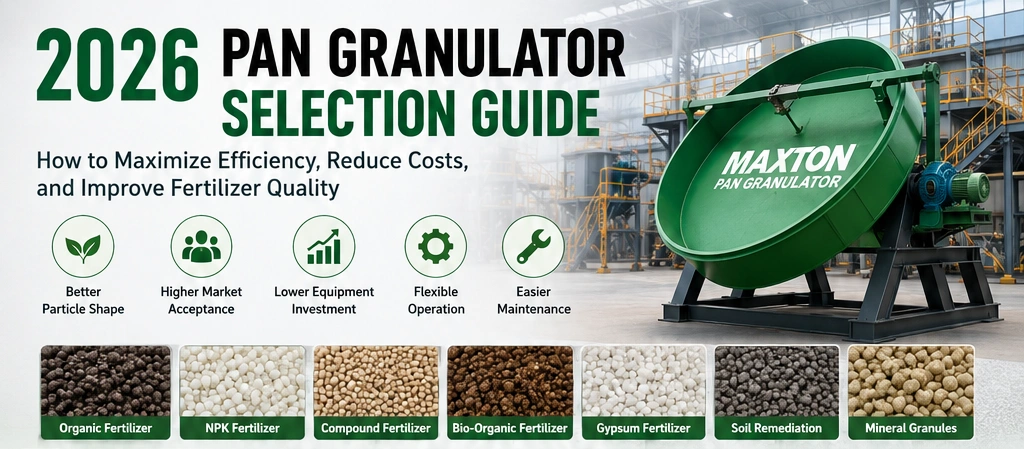
As global agriculture moves toward precision farming, sustainable fertilization, and carbon-conscious production, fertilizer manufacturers face increasing pressure to improve both product quality and production efficiency.
Whether producing organic fertilizer, NPK fertilizer, gypsum fertilizer, biofertilizer, or soil amendment granules, the granulation stage directly impacts pellet appearance, market value, operating costs, and plant profitability.
Among all granulation technologies available today, the pan granulator (disc granulator) remains one of the most cost-effective and flexible solutions for fertilizer production.
However, not all pan granulators deliver the same results.
Many fertilizer plants struggle with common issues such as material buildup, unstable pellet quality, excessive dust generation, high recycle rates, and frequent maintenance downtime.
This guide explains how to choose the right pan granulator in 2026 and how advanced equipment design can solve the industry’s most common production challenges.
Why Pan Granulators Continue to Dominate Fertilizer Production
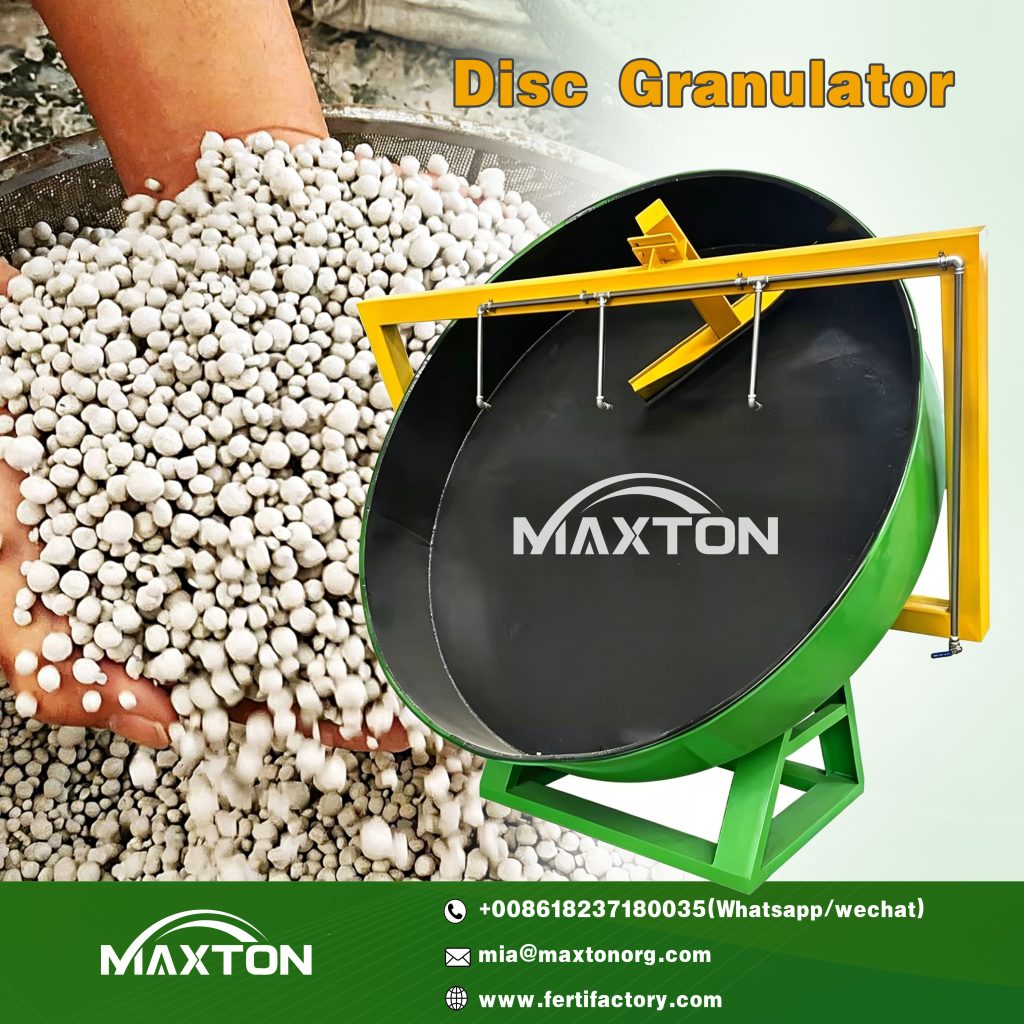
Pan granulators are widely used for producing:
- Organic fertilizer pellets
- NPK fertilizer granules
- Compound fertilizer
- Bio-organic fertilizer
- Gypsum fertilizer
- Soil remediation fertilizer
- Mineral-based granules
Unlike extrusion or compaction systems, pan granulators create pellets through a natural rolling and layering process, resulting in:
✅ Better particle shape
✅ Higher market acceptance
✅ Lower equipment investment
✅ Flexible operation
✅ Easier maintenance
For many fertilizer producers, a properly configured disc granulator delivers the ideal balance between pellet quality and operating cost.
Factor #1: Raw Material Characteristics Determine Granulation Success
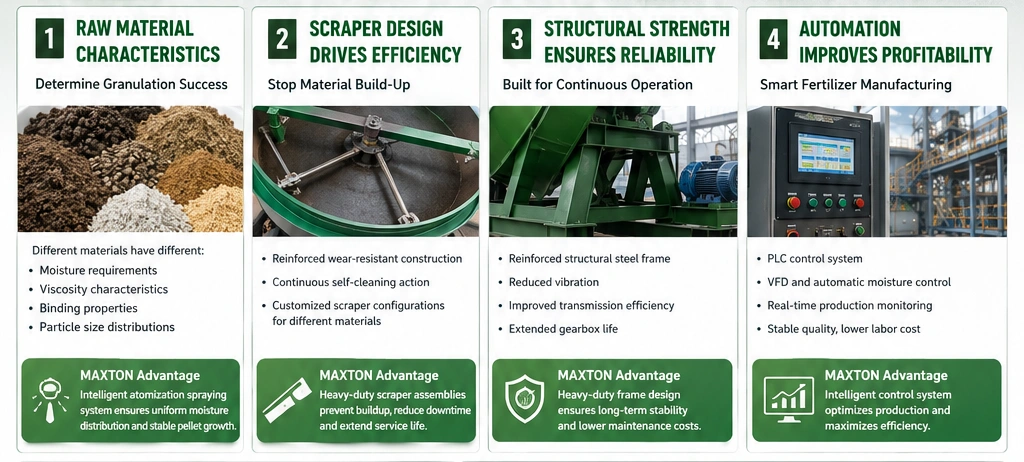
The first step in selecting a pan granulator is understanding your raw materials.
Different fertilizers behave differently during granulation.
Common materials include:
Organic Fertilizer Materials
- Poultry manure
- Cow manure
- Pig manure
- Compost
- Agricultural waste
- Fermented biomass
Compound Fertilizer Materials
- Urea
- Phosphate powder
- Potassium sulfate
- Potassium chloride
- Micronutrient additives
Soil Amendment Materials
- Gypsum powder
- Bentonite
- Lime powder
- Mineral conditioners
Each material has different:
- Moisture requirements
- Viscosity characteristics
- Binding properties
- Particle size distributions
Choosing the wrong granulator configuration often leads to poor pellet quality and production instability.
The Moisture Control Problem Most Fertilizer Plants Face
One of the biggest causes of poor granulation performance is uncontrolled moisture.
Many manufacturers still rely on manual water addition, creating:
- Oversized pellets
- Excessive fines
- Material agglomeration
- High recycling rates
- Production instability
When moisture exceeds the optimal range, pellets quickly become oversized and irregular.
When the moisture is too low, the granules fail to grow properly and generate excessive dust.
How MAXTON Solves the Moisture Challenge
Unlike conventional systems, MAXTON pan granulators can be equipped with an intelligent atomization spraying system.
Instead of pouring water directly onto materials, the system creates ultra-fine mist droplets that distribute moisture evenly throughout the granulation zone.
Benefits include:
- More uniform pellet growth
- Improved granule strength
- Lower recycling rates
- Reduced dust generation
- Stable production capacity
This technology allows fertilizer manufacturers to maintain consistent product quality even when raw material moisture fluctuates.
Factor #2: Scraper Design Can Make or Break Production Efficiency
Most fertilizer plant operators eventually encounter the same issue:
Material sticks to the bottom and sidewalls of the pan.
As the buildup increases:
- Granulation efficiency drops
- Pellet size becomes inconsistent
- Production capacity decreases
- Cleaning downtime increases
Many low-cost granulators use simple scraper systems that wear quickly and lose effectiveness.
How MAXTON Eliminates Material Build-Up
MAXTON utilizes heavy-duty scraper assemblies specifically designed for continuous industrial operation.
Key advantages include:
Reinforced Wear-Resistant Construction
High-wear components are manufactured from abrasion-resistant materials that significantly extend service life.
Continuous Self-Cleaning Action
The scraper continuously removes adhered material from the pan surface, preventing dead zones from forming.
Customized Scraper Configurations
Different materials require different scraper designs.
MAXTON engineers customize scraper geometry based on:
- Organic fertilizer
- NPK fertilizer
- Gypsum fertilizer
- Soil amendment granules
The result is:
- Lower maintenance costs
- Improved granule consistency
- Higher production efficiency
- Longer equipment life
Factor #3: Structural Strength Determines Long-Term Reliability
A pan granulator operates under constant dynamic loads.
Every minute, tons of material move across the inclined rotating disc.
Inferior frames often suffer from:
- Structural deformation
- Excessive vibration
- Gearbox wear
- Bearing failure
These problems dramatically increase maintenance costs over time.
The MAXTON Heavy-Duty Frame Advantage
MAXTON pan granulators utilize reinforced structural steel construction designed specifically for industrial fertilizer production.
Benefits include:
- Higher operational stability
- Reduced vibration
- Improved transmission efficiency
- Extended gearbox life
- Lower maintenance frequency
For plants operating continuously, frame rigidity directly affects long-term profitability.
Factor #4: Automation Is No Longer Optional
In 2026, competitive fertilizer production depends on automation.
Modern plants require:
- Stable pellet quality
- Reduced labor costs
- Production data monitoring
- Predictable output
A pan granulator should function as part of a complete intelligent production system.
Smart Fertilizer Manufacturing with MAXTON
MAXTON integrates:
- PLC control systems
- Variable frequency drives (VFD)
- Automatic moisture control
- Automated feeding systems
- Production monitoring solutions
This allows real-time adjustment of:
- Disc speed
- Water addition
- Feed rate
- Pellet size distribution
The result is a more stable process and higher production efficiency.
Pan Granulator vs Rotary Drum Granulator
Many investors ask:
Which granulation technology is better?
The answer depends on production goals.
| Feature | Pan Granulator | Rotary Drum Granulator |
|---|---|---|
| Pellet Shape | Excellent | Good |
| Product Appearance | Excellent | Good |
| Initial Investment | Lower | Higher |
| Capacity | Medium | Large |
| Process Flexibility | High | Medium |
| Maintenance | Easier | More Complex |
For most organic fertilizer plants and specialty fertilizer producers, pan granulators offer the best balance between investment cost and product quality.
Real Project Applications
MAXTON pan granulators are widely used in:
Organic Fertilizer Plants
Producing premium organic fertilizer from:
- Poultry manure
- Livestock manure
- Agricultural residues
NPK Fertilizer Production
Manufacturing uniform compound fertilizer pellets with excellent market appearance.
Gypsum Fertilizer Production
Converting fine gypsum powder into durable, dust-free granules.
Soil Remediation Projects
Producing soil conditioning granules for land improvement and environmental restoration.
Return on Investment: Why Choosing the Right Granulator Matters
A properly configured granulation system can significantly improve profitability.
Typical benefits include:
- 10–20% higher granulation efficiency
- Reduced recycling rates
- Lower labor costs
- Reduced equipment downtime
- Higher product selling prices
For many fertilizer plants, upgrading to a modern granulation system can achieve payback within 12–24 months.
Frequently Asked Questions About Pan Granulator Selection
1. What raw materials can be processed by a pan granulator?
Pan granulators are suitable for a wide range of materials, including organic fertilizer, compost, poultry manure, cow manure, NPK fertilizer, gypsum powder, bentonite, phosphate powder, and various soil amendment products.
Material characteristics should always be evaluated before selecting equipment specifications.
2. What capacity pan granulator is suitable for a 50,000-ton fertilizer plant?
For a fertilizer plant producing approximately 50,000 tons annually, a disc granulator with a diameter of around 4.2 meters is typically recommended.
However, the final equipment selection should also consider:
- Operating hours
- Raw material properties
- Product specifications
- Future expansion plans
MAXTON provides customized capacity calculations based on actual project requirements.
3. How does MAXTON ensure stable pellet quality and low maintenance costs?
MAXTON combines intelligent atomization spraying systems, heavy-duty scraper assemblies, and reinforced structural frames to address the three most common causes of granulation failure:
- Moisture fluctuations
- Material buildup
- Equipment vibration
This integrated design improves pellet uniformity, reduces downtime, and extends equipment service life.
4. Can one pan granulator produce both organic fertilizer and NPK fertilizer?
Yes.
With proper adjustments to moisture levels, rotational speed, and formulation parameters, a single pan granulator can produce multiple fertilizer products, improving equipment utilization and investment efficiency.
Build a Smarter Fertilizer Plant with MAXTON
Choosing the right pan granulator is about more than capacity.
It requires balancing:
- Raw material compatibility
- Moisture control
- Automation
- Structural durability
- Product quality
- Long-term operating costs
MAXTON provides complete fertilizer production solutions, including:
- Pan Granulators
- Rotary Drum Granulators
- Double Roller Press Granulators
- Fertilizer Dryers
- Fertilizer Coolers
- Screening Systems
- Automatic Packaging Equipment
- EPC Fertilizer Plant Engineering
Whether you are building a new fertilizer factory or upgrading an existing production line, our engineering team can help you design the most efficient solution for your project.
Contact MAXTON today for a customized fertilizer production plan and equipment recommendation.
Email: svip@maxtonorg.com
Website: MAXTON Fertilizer Equipment Solutions
Whatsapp:+86-18237180035
Related Posts
9 月 15, 2026
Fertilizer Plant Cost in 2026: Real Budget Ranges for Organic, Liquid, and NPK Production
Quick answer: A small organic fertilizer plant can start under $50,000. A commercial granular fertil...
8 月 24, 2026
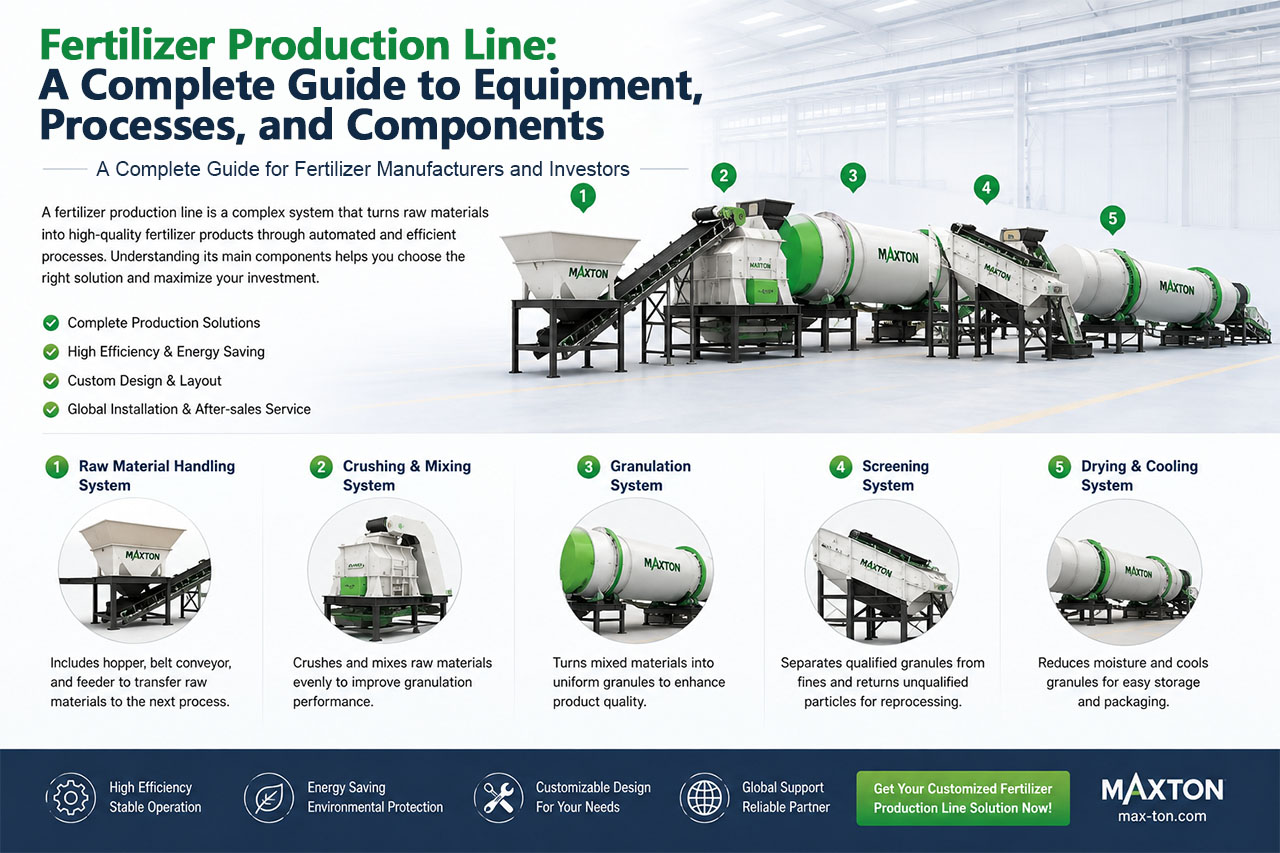
Fertilizer Production Line: A Complete Guide to Equipment, Processes, and Components
What Are the Main Components of a Fertilizer Production Line? A complete fertilizer production line ...
Give us a call or Simply Complete the Form
Address:Zhengzhou City, Henan Province, ChinaPhone:+86-18237180035Email:svip@maxtonorg.com