SINO MAXTON GROUP Co.,Ltd
News Details
Fertilizer Production Line: A Complete Guide to Equipment, Processes, and Components
What Are the Main Components of a Fertilizer Production Line?
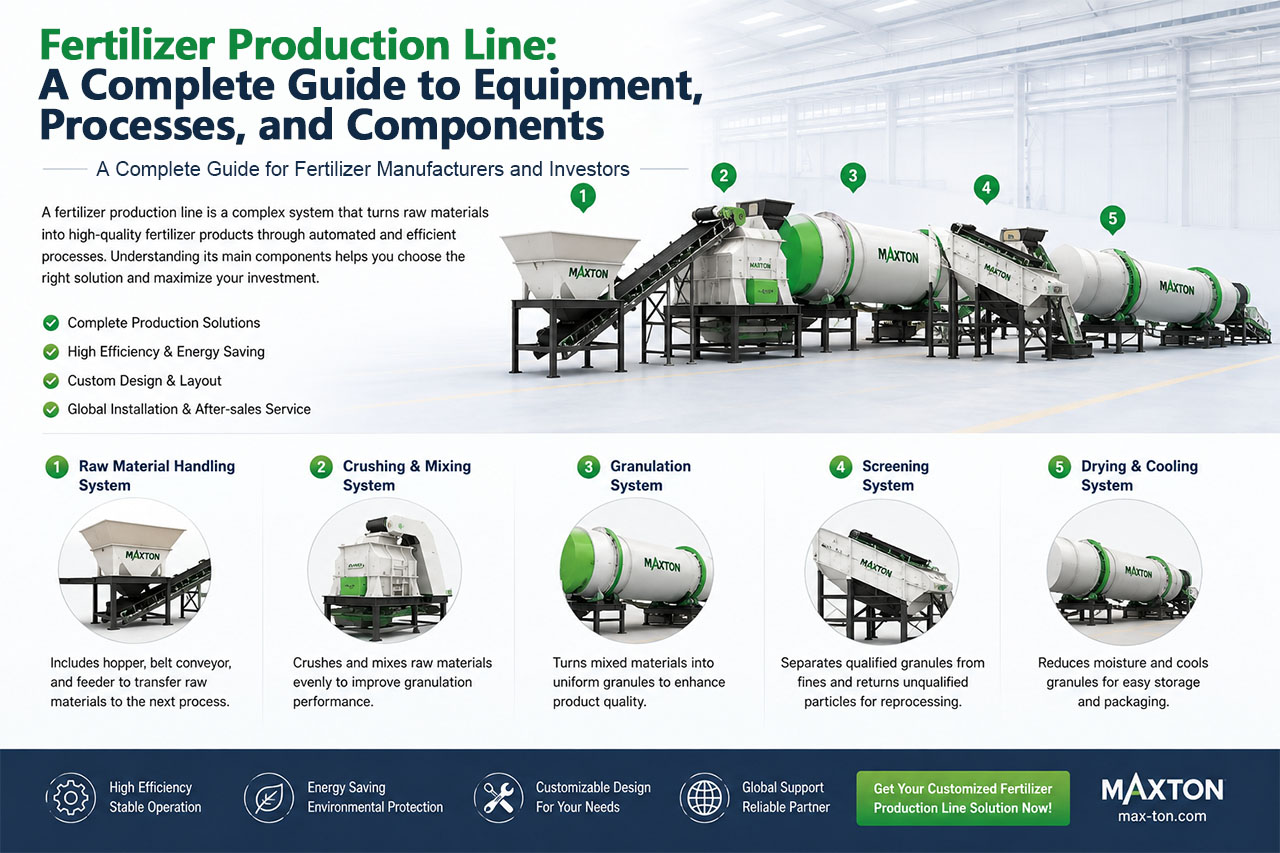
A complete fertilizer production line is an integrated system that converts raw materials into uniform, high-quality fertilizer products through a series of controlled processes. Depending on the fertilizer type, raw materials, production capacity, and required product specifications, a fertilizer plant may include raw material handling, crushing, batching, mixing, granulation, drying, cooling, screening, coating, conveying, dust collection, and packaging systems.
For fertilizer manufacturers and investors, understanding these components is essential when selecting equipment, estimating investment costs, designing the plant layout, and evaluating suppliers.
In this guide, we explain the main components of a fertilizer production line, what each system does, how the equipment works together, and what buyers should consider before purchasing a complete fertilizer production line.
Fertilizer Production Line Process at a Glance
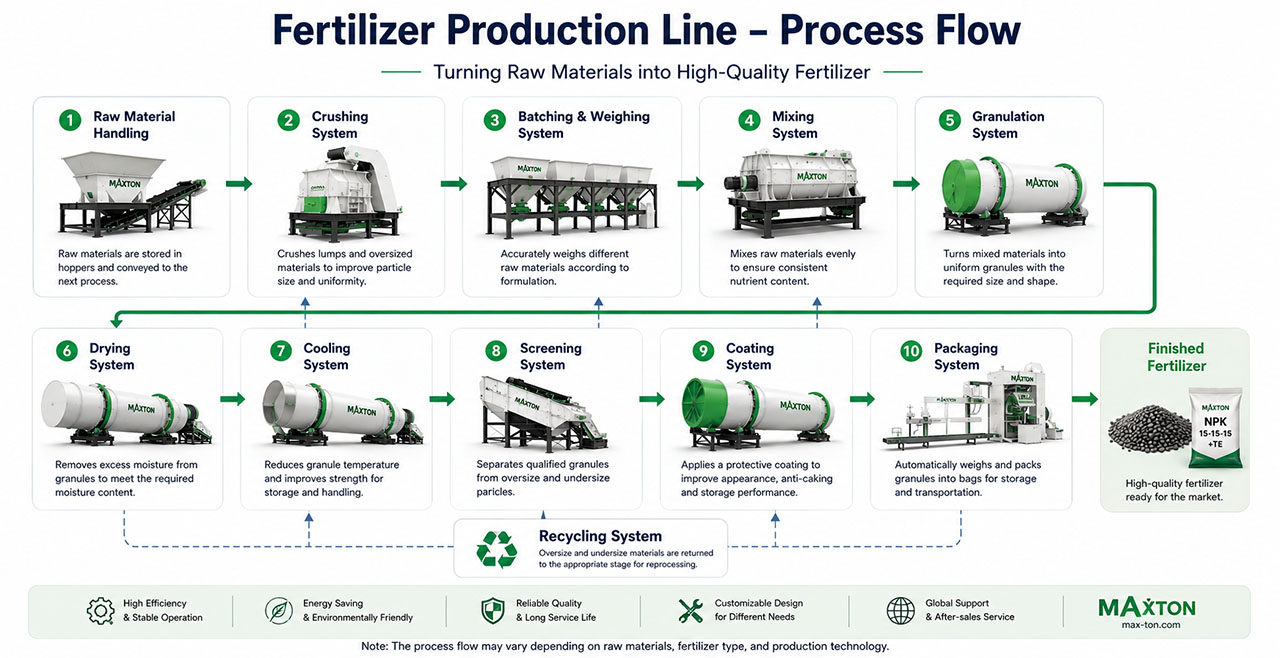
A typical granular fertilizer production line follows this general process:
Raw Material Handling → Crushing → Batching → Mixing → Granulation → Drying → Cooling → Screening → Coating → Packaging
Conveyors, bucket elevators, dust collection systems, heating systems, and electrical/PLC controls support the main process throughout the plant.
Not every fertilizer production line requires every machine. For example, a dry extrusion or roller-compaction process may eliminate the need for conventional drying, while an organic fertilizer plant may require fermentation and compost preparation before granulation.
The correct equipment configuration should therefore be designed around the raw materials, fertilizer formula, target capacity, granule size, moisture requirements, and final product specifications.
1. Raw Material Handling System
The raw material handling system is the starting point of a fertilizer production line.
Fertilizer plants may process materials such as:
- Urea
- Ammonium sulfate
- DAP
- MAP
- Potassium chloride
- Potassium sulfate
- Phosphate materials
- Organic compost
- Animal manure
- Humic substances
- Trace elements and micronutrients
- Other mineral or organic fertilizer ingredients
Depending on the plant design, raw materials can be stored in hoppers, silos, storage bins, or feeding stations.
Main equipment
Common equipment includes:
- Raw material hoppers
- Storage bins
- Belt conveyors
- Screw conveyors
- Bucket elevators
- Feeders
- Automatic weighing systems
The purpose is to ensure that raw materials are delivered continuously and reliably to the next stage.
For fertilizer production projects, the handling system should be designed according to material characteristics, storage requirements, plant layout, and target production capacity.
2. Crushing System
Raw materials may contain lumps or oversized particles that can affect mixing and granulation.
A crushing system reduces these materials to a more suitable particle size and improves material uniformity before the mixing and granulation stages.
Common fertilizer crushers include:
- Chain crushers
- Cage crushers
- Hammer crushers
- Vertical crushers
- Semi-wet material crushers
The appropriate crusher depends on the raw material’s hardness, moisture content, particle size, and required output.
For example, some compound fertilizer lines use chain or cage crushers for fertilizer raw materials, while organic fertilizer lines may require crushers specifically designed to handle higher-moisture organic materials.
Why crushing matters
Proper crushing helps:
- Improve raw material uniformity
- Reduce oversized particles
- Improve mixing performance
- Stabilize the granulation process
- Reduce the risk of large lumps in the finished product
For a complete fertilizer plant, size the crusher based on the actual feed rate rather than selecting it independently.
3. Batching and Weighing System
The batching system controls how much of each raw material enters the production process.
This is particularly important for NPK fertilizer production, where different raw materials must be combined according to a specific nutrient formula.
An automatic batching system typically uses multiple bins and weighing devices to measure and feed different ingredients at controlled rates.
Main functions
The batching system:
- Stores different raw materials.
- Measures each ingredient.
- Controls the feeding ratio.
- Sends the materials to the mixer.
- Helps maintain consistent fertilizer formulation.
For fertilizer manufacturers producing multiple grades, an automatic batching system can also make formula changes faster and reduce manual weighing.
Fertilizer production plant purchasing considerations
When comparing suppliers, buyers should look beyond the nominal capacity of the batching machine.
Important specifications include:
- Number of material bins
- Weighing accuracy
- Feeding range
- Formula management
- Automation level
- Compatibility with different raw materials
- Integration with the PLC control system
A reliable batching system is one of the most important factors affecting final nutrient consistency.
4. Fertilizer Mixing System
After batching, the raw materials need to be mixed evenly before granulation.
The mixer creates a relatively homogeneous mixture of the major nutrients, secondary nutrients, micronutrients, moisture, and other additives required by the formulation.
Common fertilizer mixers
Depending on the application, a fertilizer plant may use:
- Double-shaft horizontal mixers
- Single-shaft mixers
- Disc mixers
- Ribbon mixers
- Continuous mixers
The mixer should provide sufficient mixing uniformity without creating excessive material buildup or unnecessary energy consumption.
Why mixing is important
Poor mixing can cause:
- Nutrient segregation
- Uneven fertilizer composition
- Inconsistent granule quality
- Unstable granulation
- Product quality problems downstream
The mixer capacity should therefore be matched to the batching and granulation capacity.
5. Fertilizer Granulation System
The granulator is the core machine of many fertilizer production lines.
Its main function is to convert prepared powder or conditioned material into fertilizer granules with a controlled size and shape.
Different granulation technologies are available, and the best choice depends heavily on the raw material and production requirements.
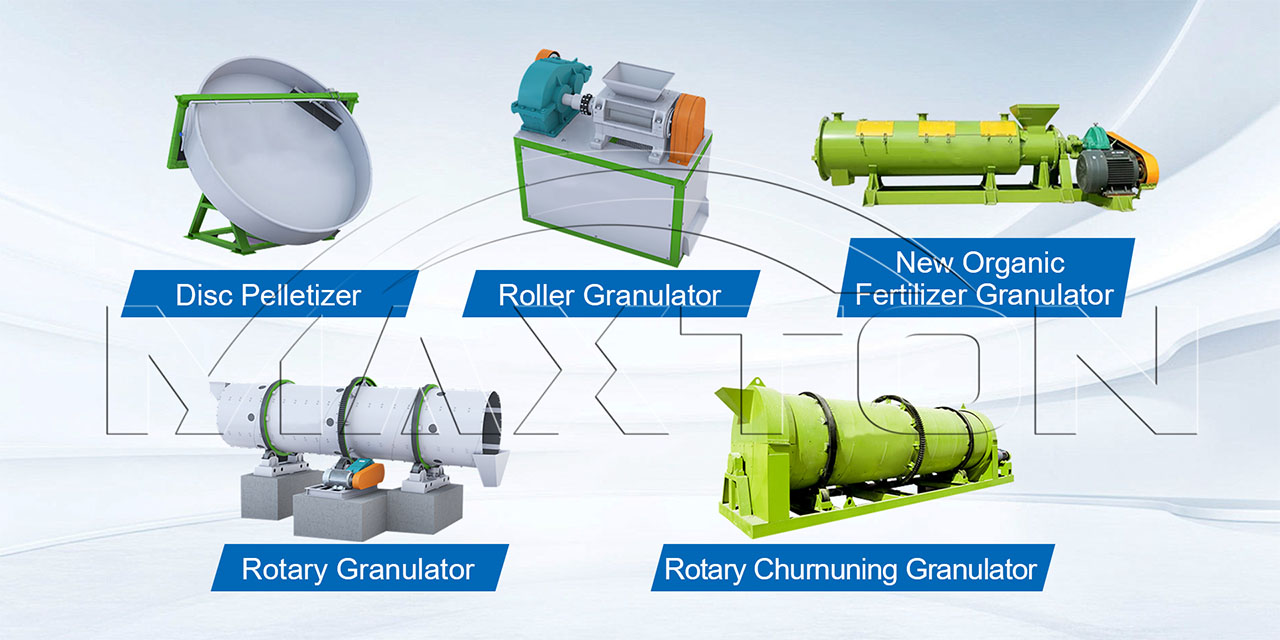
Common Fertilizer Granulators
Rotary Drum Granulator
A rotary drum granulator forms granules as material rolls and agglomerates inside a rotating drum.
It is widely used for medium- and large-scale compound and NPK fertilizer production.
Disc Pan Granulator
A disc granulator uses a rotating inclined pan to form spherical fertilizer granules.
It is often used for organic fertilizer and compound fertilizer applications where a relatively simple and flexible granulation process is required.
Double Roller Compactor
A double roller granulator uses mechanical pressure to compress dry powder between two rollers.
One advantage is that dry granulation can reduce or eliminate the need for conventional drying, depending on the raw material and formulation.
Extrusion Granulator
Extrusion granulation forms fertilizer particles through mechanical extrusion.
It can be suitable for certain NPK and compound fertilizer formulations, particularly where a relatively compact production process is preferred.
How to choose the right granulator
The granulator should not be selected based only on advertised capacity.
A professional equipment supplier should evaluate:
- Raw material composition
- Moisture content
- Fertilizer formula
- Required granule size
- Desired granule shape
- Production capacity
- Whether drying is required
- Energy availability
- Final product requirements
The granulation method also influences the selection of downstream equipment such as dryers, coolers, screens, and coating machines.
6. Fertilizer Drying System
Wet granulation processes usually produce granules containing excess moisture.
A fertilizer dryer removes this moisture using controlled hot air so that the granules can meet the required moisture level for storage, transportation, and further processing.
Common equipment
The most common equipment is:
Rotary Drum Dryer
A typical drying system may also include:
- Hot air furnace or burner
- Induced-draft fan
- Cyclone
- Dust collector
- Ductwork
- Temperature control system
Drying requirements vary considerably according to fertilizer type and process design.
Why drying matters
Proper drying helps improve:
- Storage stability
- Granule strength
- Anti-caking performance
- Packaging performance
- Transportation stability
However, not every fertilizer production line requires a rotary dryer. Dry granulation technologies, including some roller-compaction processes, can reduce or eliminate conventional drying requirements.
Therefore, drying equipment should be determined by the selected granulation technology rather than automatically included in every project.
7. Fertilizer Cooling System
After drying, fertilizer granules may still be too hot for screening, coating, packaging, or long-term storage.
A cooling system reduces the granule temperature and helps stabilize the finished product.
Common equipment
The most widely used solution is a:
Rotary Drum Cooler
The cooler can be integrated with fans, cyclones, ducts, and dust collection equipment.
Benefits of cooling
An effective cooling system can help:
- Reduce product temperature
- Improve storage stability
- Reduce caking risk
- Protect packaging materials
- Prepare granules for screening and coating
Drying and cooling are normally designed as a matched system because the required capacity and material residence time depend on the upstream granulator and the final moisture target.
8. Screening System
After granulation, drying, and cooling, the fertilizer is screened according to particle size.
The screening system separates:
- Qualified granules
- Oversized particles
- Undersized particles or fines
Only granules within the required size range are sent to the finished-product section.
Common screening equipment
- Rotary screening machines
- Trommel screens
- Vibrating screens
- Multi-deck screening machines
A closed-loop fertilizer production line usually returns oversized and undersized materials to the appropriate upstream process for reprocessing.
This recycling system can improve raw material utilization and reduce product loss.
Why screening is critical
Consistent particle size improves:
- Product appearance
- Application uniformity
- Bulk handling
- Packaging performance
- Customer acceptance
For fertilizer manufacturers and investors,, screening efficiency should therefore be evaluated together with the granulator rather than treated as an independent machine.
9. Fertilizer Coating System
Coating is an optional but valuable stage for many fertilizer products.
A coating machine applies a thin layer of liquid or solid coating material to the surface of fertilizer granules.
Depending on the product, coating may be used for:
- Anti-caking
- Moisture resistance
- Improved appearance
- Controlled nutrient release
- Additional micronutrient application
- Surface protection
Common equipment
A fertilizer coating system may include:
- Rotary coating machine
- Coating drum
- Liquid spraying system
- Pump
- Atomizing nozzles
- Mixing tank
Not every fertilizer product needs coating, so this system should be included according to the product’s market positioning and technical requirements.
10. Fertilizer Packaging System
Packaging is the final major processing stage before fertilizer enters storage, distribution, and the market.
An automatic fertilizer packaging machine weighs the finished fertilizer and fills bags according to the selected package size.
Typical packaging options may include:
- 10 kg bags
- 20 kg bags
- 25 kg bags
- 40 kg bags
- 50 kg bags
- Jumbo bags / big bags
The actual package size depends on the target market and sales channel.
A complete packing system may include:
- Automatic weighing machine
- Bag filling machine
- Bag-clamping system
- Bag sewing or sealing machine
- Conveyor
- Checkweigher
- Palletizing system
For large fertilizer plants, automatic packaging and palletizing can significantly reduce manual labor and improve production consistency.
11. Conveying System
Although conveyors are not usually considered the “main process machines,” they are essential to a complete fertilizer production line.
They connect individual machines and continuously transfer materials between processing stages.
Common conveying equipment
- Belt conveyors
- Bucket elevators
- Screw conveyors
- Scraper conveyors
- Vibrating feeders
The conveying system must be designed according to:
- Material characteristics
- Throughput
- Transfer distance
- Elevation changes
- Plant layout
- Dust-control requirements
Poorly designed material transfer systems can become bottlenecks even when the main processing machines have sufficient capacity.
12. Dust Collection and Environmental Protection System
Fertilizer production can generate dust during crushing, mixing, screening, drying, conveying, and packaging.
A dust collection system helps capture airborne particles and improve the working environment.
Depending on the process, a complete system may include:
- Cyclones
- Bag filters
- Dust collectors
- Fans
- Ductwork
- Exhaust systems
The exact environmental-control configuration should comply with the regulations applicable to the project’s location.
For an industrial project, environmental equipment should be considered during the initial plant design rather than added after installation.
13. Electrical and PLC Control System
Modern fertilizer production lines increasingly use centralized electrical and PLC control systems.
The control system coordinates equipment operation and allows operators to monitor key production parameters.
Typical functions include:
- Motor start/stop control
- Automatic batching
- Conveyor interlocking
- Temperature monitoring
- Dryer control
- Granulator control
- Alarm management
- Production monitoring
- Emergency shutdown
- Recipe management
The automation level can range from basic machine-by-machine control to a fully integrated automated production line.
For plants producing multiple fertilizer grades, advanced automation can help reduce operator workload and improve production repeatability.
Complete Fertilizer Production Line Equipment List
For a typical granular NPK or compound fertilizer plant, the equipment configuration may include:
| Production Stage | Main Equipment | Main Function |
| Raw Material Handling | Hopper, feeder, conveyor | Receive and transfer materials |
| Crushing | Chain crusher, cage crusher | Reduce particle size |
| Batching | Automatic batching system | Accurately dose ingredients |
| Mixing | Double-shaft mixer | Homogenize raw materials |
| Granulation | Drum, disc, roller or extrusion granulator | Form fertilizer granules |
| Drying | Rotary drum dryer | Reduce moisture |
| Cooling | Rotary cooler | Reduce granule temperature |
| Screening | Rotary or vibrating screener | Separate particle sizes |
| Coating | Coating machine | Apply surface treatment |
| Conveying | Belt conveyor, bucket elevator, screw conveyor | Transfer materials |
| Dust Collection | Cyclone, bag filter, dust collector | Control process dust |
| Packaging | Automatic packing machine | Weigh and bag finished product |
| Control | PLC and electrical system | Coordinate the complete line |
This configuration is a general reference. A real fertilizer production line should be engineered according to the specific product and project requirements.
What Determines the Configuration of a Fertilizer Production Line?
There is no single standard equipment list that is suitable for every fertilizer factory.
The final configuration is normally determined by six major factors.
1. Fertilizer Type
The production process for:
- NPK fertilizer
- Compound fertilizer
- Organic fertilizer
- Organic-mineral fertilizer
- BB fertilizer
- Urea-based fertilizer
- Specialty fertilizer
can be significantly different.
For example, organic fertilizer production may require fermentation and organic-material preprocessing, while a dry NPK compaction line may use a different granulation route.
2. Raw Material Characteristics
Before equipment selection, the supplier should evaluate:
- Moisture
- Particle size
- Bulk density
- Hardness
- Stickiness
- Chemical composition
- Corrosiveness
- Flowability
These characteristics directly affect crusher, mixer, granulator, dryer, and conveyor selection.
3. Production Capacity
Capacity is one of the most important parameters in fertilizer plant design.
A buyer may require a small production line for local agricultural markets or a large industrial plant producing several tons per hour.
The capacity of individual machines must be matched throughout the process.
For example:
Batching Capacity ≈ Mixing Capacity ≈ Granulation Capacity ≈ Drying Capacity ≈ Screening Capacity ≈ Packaging Capacity
A bottleneck in any stage can limit the actual output of the entire line.
4. Desired Granule Size and Product Quality
The target particle size and granule shape influence the granulation technology, screening system, and recycling design.
If the customer requires narrow particle-size distribution and high visual quality, the screening and recycling system becomes particularly important.
5. Factory Layout
The available building area and site conditions influence:
- Equipment arrangement
- Conveyor length
- Elevators
- Material flow
- Maintenance access
- Finished-product storage
- Dust collection
- Electrical installation
A good layout should minimize unnecessary material movement while leaving sufficient space for operation and maintenance.
6. Automation Level
A fertilizer plant can be designed with different automation levels.
Semi-Automatic Line
Suitable for projects where:
- Initial investment needs to be controlled
- Labor is readily available
- Production capacity is relatively small
Fully Automatic Line
Suitable for projects where:
- Labor costs are high
- Production capacity is large
- Multiple fertilizer formulas are produced
- Consistent product quality is important
- Real-time production monitoring is required
The right automation level should balance investment, labor costs, production requirements, and expected return on investment.
How to Choose a Fertilizer Production Line Supplier?
Selecting the right equipment supplier is as important as selecting the machines themselves.
We should evaluate suppliers based on the complete project rather than comparing individual machine prices only.
1. Can the supplier provide a complete solution?
A reliable supplier should be able to provide process design, equipment selection, layout planning, manufacturing, installation guidance, commissioning, and after-sales support.
2. Does the supplier understand your raw materials?
Equipment selection should be based on actual material characteristics.
Ask the supplier whether they can conduct material testing or recommend a process based on your raw materials.
3. Is the capacity realistic?
Do not compare suppliers based only on theoretical machine capacity.
Ask for:
- Rated capacity
- Actual production conditions
- Material assumptions
- Final product specifications
- Energy consumption
- Expected operating efficiency
4. Can the production line be customized?
A fertilizer plant should be adapted to the customer’s:
- Product formula
- Capacity
- Site dimensions
- Local energy source
- Environmental requirements
- Packaging specifications
- Budget
5. What after-sales support is available?
For an overseas fertilizer project, buyers should consider:
- Installation guidance
- Commissioning
- Operator training
- Spare parts
- Technical support
- Maintenance documentation
A lower equipment price does not necessarily mean a lower total project cost.
Why Choose MAXTON for a Fertilizer Production Line?
MAXTON provides customized fertilizer production equipment and complete production-line solutions for different fertilizer applications.
Instead of simply supplying individual machines, MAXTON can help customers evaluate the complete process, including:
- Raw material preparation
- Crushing
- Batching
- Mixing
- Granulation
- Drying
- Cooling
- Screening
- Coating
- Conveying
- Dust collection
- Packaging
- Electrical and PLC control
The production line can be customized according to fertilizer type, raw material characteristics, production capacity, granule specifications, factory layout, and investment requirements.
For fertilizer manufacturers and investors, this integrated approach helps reduce compatibility problems between individual machines and makes it easier to manage the overall project.
Fertilizer Production Line FAQ
1. What are the main components of a fertilizer production line?
The main components typically include raw material handling, crushing, batching, mixing, granulation, drying, cooling, screening, coating, conveying, dust collection, packaging, and electrical control systems. The exact configuration depends on the fertilizer type and production process.
2. What is the most important machine in a fertilizer production line?
For many granular fertilizer plants, the granulator is the key process machine because it determines how the prepared material is converted into fertilizer granules. However, the granulator must be matched with the upstream mixing system and downstream drying, cooling, screening, and recycling equipment.
3. Does every fertilizer production line need a dryer?
No. Drying is mainly required when the selected process produces granules with excess moisture. Some dry granulation technologies, such as certain roller-compaction processes, can reduce or eliminate the need for conventional drying.
4. What equipment is needed for an NPK fertilizer production line?
A typical NPK production line may include an automatic batching system, crusher, mixer, granulator, dryer, cooler, screener, coating machine, conveyors, dust collection system, and automatic packing machine. The exact equipment depends on the NPK formula, raw materials, granulation technology, and production capacity.
5. Can a fertilizer production line be customized?
Yes. A fertilizer production line should normally be customized according to raw materials, fertilizer formula, capacity, granule size, moisture requirements, factory layout, energy source, and automation requirements.
6. How do I choose the right fertilizer production line?
Start with the fertilizer type, raw materials, target capacity, granule specifications, and available factory space. Then select the granulation technology and design the supporting drying, cooling, screening, conveying, packaging, dust collection, and control systems around it.
Final Takeaway
A fertilizer production line is not simply a collection of individual machines. It is an integrated processing system in which every stage affects the performance of the next stage.
The main components generally include:
Raw Material Handling → Crushing → Batching → Mixing → Granulation → Drying → Cooling → Screening → Coating → Packaging
Conveying, dust collection, heating, electrical control, and automation systems provide the infrastructure needed to keep the entire line operating efficiently.
For fertilizer manufacturers and investors, the best fertilizer production line is not necessarily the one with the most machines or the lowest equipment price. It is the system that is properly matched to the raw materials, fertilizer formula, production capacity, product quality requirements, factory layout, energy conditions, and investment budget.
If you are planning a new fertilizer plant or upgrading an existing production line, MAXTON can help you develop a customized equipment configuration and production-line solution based on your actual requirements.
Contact MAXTON today for a customized fertilizer production line proposal, equipment configuration, and project solution.
Email: sales@maxtonorg.com
Website: MAXTON Fertilizer Equipment Solutions
Whatsapp:+86-18237180035
Related Posts
9 月 15, 2026
Fertilizer Plant Cost in 2026: Real Budget Ranges for Organic, Liquid, and NPK Production
Quick answer: A small organic fertilizer plant can start under $50,000. A commercial granular fertil...
8 月 24, 2026
Fertilizer Production Line: A Complete Guide to Equipment, Processes, and Components
What Are the Main Components of a Fertilizer Production Line? A complete fertilizer production line ...
Give us a call or Simply Complete the Form
Address:Zhengzhou City, Henan Province, ChinaPhone:+86-18237180035Email:svip@maxtonorg.com