SINO MAXTON GROUP Co.,Ltd
News Details
BB Fertilizer Plant: Complete Guide to Equipment, Capacity & Setup Costs 2026
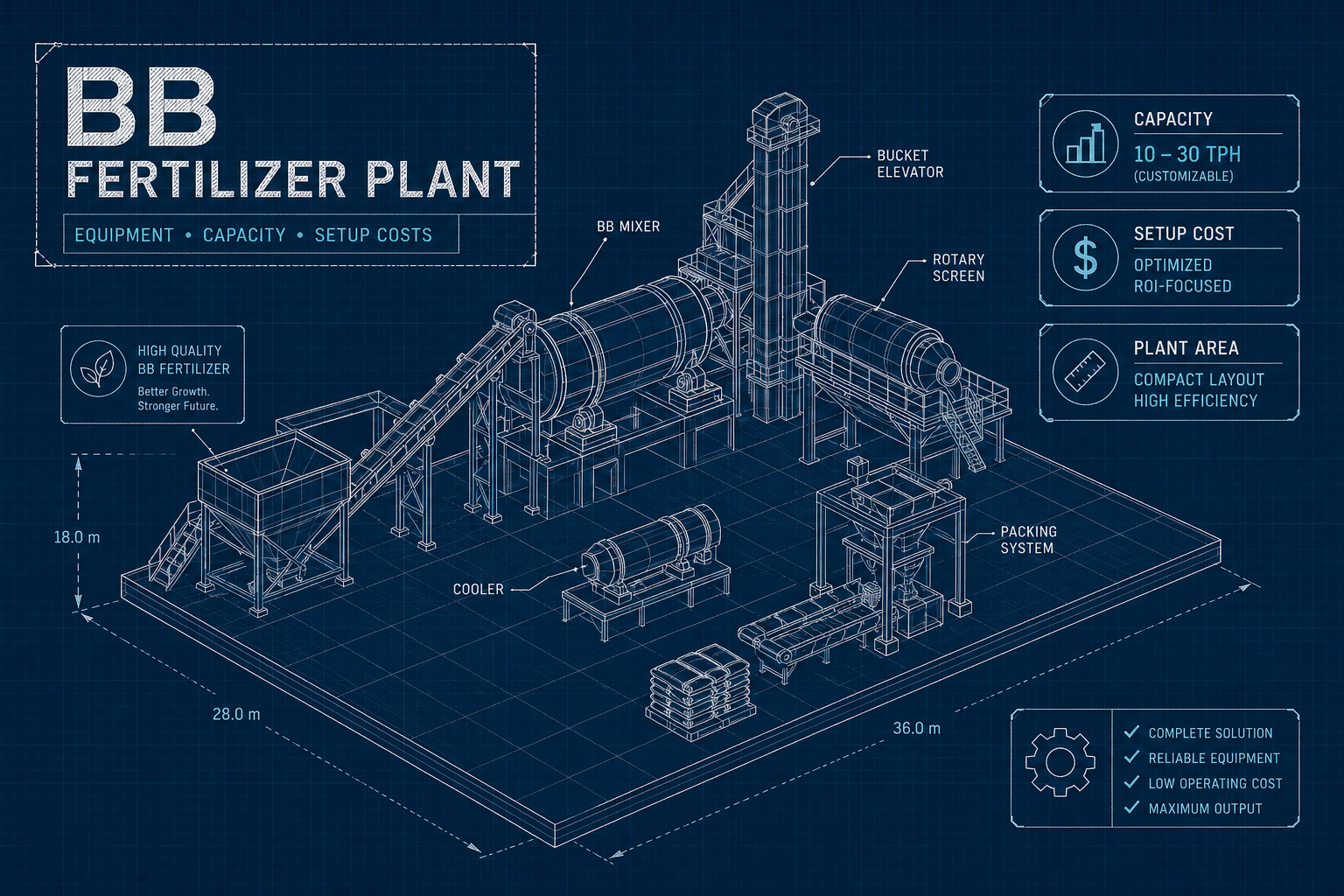
Table of Contents
-
What is a BB Fertilizer Plant?
-
BB Fertilizer vs. NPK Granulation Plant: Key Differences
-
Complete BB Fertilizer Production Process
-
BB Fertilizer Plant Equipment List
-
Capacity Tiers & Production Output Options
-
BB Fertilizer Plant Setup Costs (CAPEX)
-
Plant Footprint & Facility Requirements
-
Market Demand for BB Fertilizer
-
Turnkey BB Fertilizer Plant Solutions from Maxton
-
Frequently Asked Questions
1. What is a BB Fertilizer Plant?
A BB fertilizer plant (Bulk Blending fertilizer plant) produces blended fertilizers by physically mixing single-element fertilizer granules—such as urea (N), DAP/MAP (P), and potash (K)—along with secondary nutrients and micronutrients, according to specific formulas.
Unlike compound fertilizer production, BB fertilizer manufacturing requires no granulation, drying, or cooling processes. The raw materials are already in granular form; the plant simply weighs, blends, and packages them.
Key Characteristics of BB Fertilizer
| Property | Specification |
|---|---|
| Nutrient content | Typically ≥35% total nutrients (N+P₂O₅+K₂O) |
| Form | Granular blend (2-4 mm) |
| Water-soluble P ratio | ≥60% of available phosphorus |
| Moisture content | ≤2.0% |
| Particle size qualification | ≥70% passing 2-4 mm range |
Why BB Fertilizer is Growing in Popularity
1. Formula Flexibility – Farmers and crops have different nutrient needs. A BB plant can produce 15-15-15 for maize in the morning and 20-10-10 for wheat in the afternoon by simply changing the batching recipe.
2. Lower Capital Investment – Equipment investment for a BB fertilizer line is only 10-15% of that for an NPK granulation line of the same capacity.
3. Fast Payback – Case studies show BB plants can achieve payback in less than 12 months in high-demand markets.
4. Simple Operation – No complex chemical reactions, no high-temperature drying, no emission control headaches.
5. Ideal for Regional Markets – Agricultural cooperatives, fertilizer distributors, and small-to-medium investors find BB plants highly accessible.
2. BB Fertilizer vs. NPK Granulation Plant: Key Differences
Understanding the difference helps you decide which type of plant fits your business model.
| Factor | BB Fertilizer Plant | NPK Granulation Plant |
|---|---|---|
| Process | Physical blending of pre-made granules | Chemical reaction + granulation + drying |
| Equipment complexity | Low (batching, mixing, packaging) | High (granulator, dryer, cooler, crusher, screener, etc.) |
| Equipment investment | 30,000−200,000 (for 10-50 t/h) | 400,000−2,000,000+ (for same capacity) |
| Energy consumption | 2.8-4.5 kWh/ton | 18-25 kWh/ton |
| Floor space required | 200-500 m² | 800-2,000+ m² |
| Installation time | 15-30 days | 3-6 months |
| Formula flexibility | High (change recipe instantly) | Low (requires cleaning between batches) |
| Raw material cost | Uses finished granular inputs | Uses raw powders (rock phosphate, acid, etc.) |
| Best for | Regional blending, custom formulas | Large-scale continuous production |
Which one should you choose?
-
Choose BB plant if: You want low startup cost, formula flexibility, quick ROI, and serve regional farmers with custom blends.
-
Choose NPK granulation if: You have access to raw phosphate rock/acid, need very high volume (50,000+ t/year), or want to produce your own base granules.
3. Complete the BB Fertilizer Production Process
The BB fertilizer production process typically consists of 5 core stages.
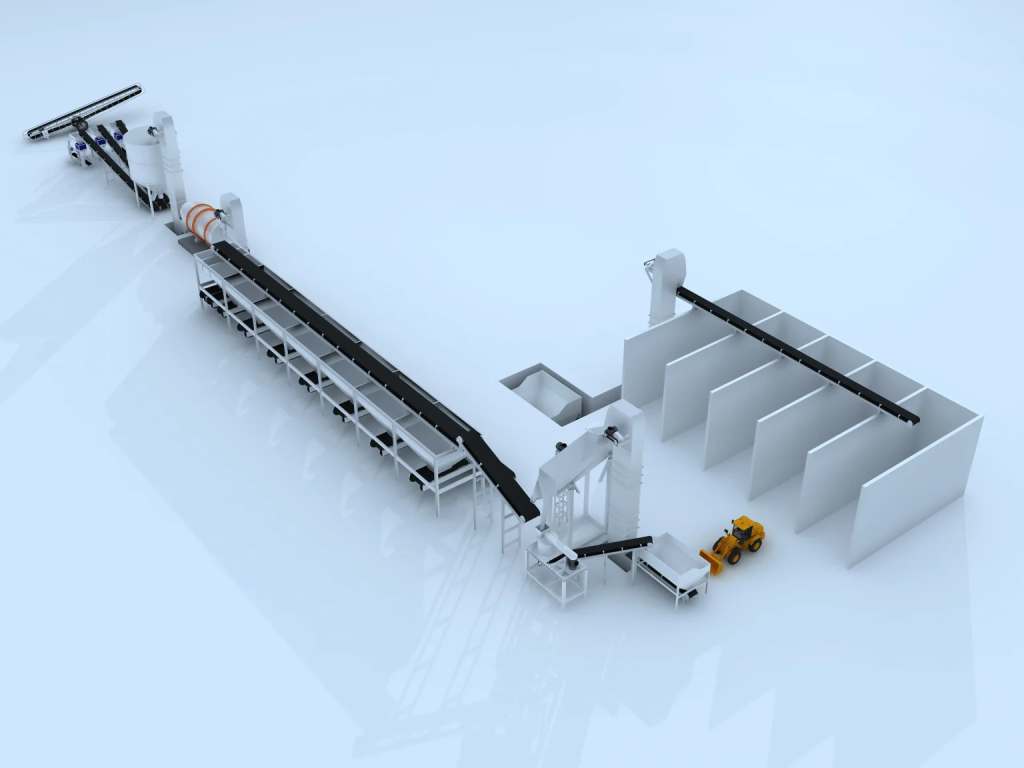
Stage 1: Raw Material Storage & Preparation
Raw materials—urea (N), DAP/MAP (P), MOP/SOP (K), and optional additives like sulfur, magnesium, boron, or zinc—are stored in separate bins or silos.
Key considerations:
-
Raw materials must be in granular form (not powder)
-
Each material should have a similar particle size to prevent segregation
-
Moisture-proof storage is essential to prevent caking
Stage 2: Automatic Batching
The automatic batching system weighs each raw material according to the target formula.
How it works:
-
Electronic belt scales or load cells measure each component
-
Accuracy typically ±0.1% to ±0.2%
-
Multiple materials can be weighed independently or cumulatively
-
Batch sizes range from 10-60 kg (for bagged blending) or 1-10 tons (for bulk blending)
Equipment used: Multi-bin batching machine, electronic belt scales, or loss-in-weight feeders
Stage 3: Mixing/Blending
The weighed materials are discharged into a blender where they are thoroughly mixed.
Mixing requirements:
-
Blend uniformity must reach ≥95%
-
Mixing time is typically 2-5 minutes per batch
-
The mixer must handle materials with different densities and particle sizes without causing segregation
Mixer types:
-
Horizontal ribbon mixer – Most common for BB fertilizers
-
Rotary drum blender – Gentle mixing, good for friable materials
-
Batch-type blender – For 1-10 ton batches, higher flexibility
-
Continuous blender – For >70 t/h, single-recipe high-volume production
Stage 4: Packaging
The blended fertilizer is conveyed to an automatic packaging machine for bagging.
Typical specifications:
-
Bag sizes: 25 kg, 40 kg, 50 kg, or 1,000 kg FIBCs
-
Packaging speed: 300-1,200 bags/hour (depending on automation level)
-
Bag types: PP woven, HDPE, laminated paper
-
Optional: Heat sealer or bag sewing machine for closure
Stage 5: Palletizing & Storage
Finished bags are palletized (manually or automatically) and stored in a warehouse before dispatch.
Optional equipment: Robot palletizer, stretch film wrapper, conveyor system
4. BB Fertilizer Plant Equipment List
A complete BB fertilizer production line typically includes the following equipment.
Core Equipment
| Equipment | Function | Specification Range |
|---|---|---|
| Raw material silos/bins | Storage of individual granular materials | 4-12 bins, custom capacity |
| Automatic batching system | Precise weighing of each component | Accuracy ±0.1-0.2%, multi-bin |
| BB fertilizer mixer/blender | Uniform blending of weighed materials | Batch or continuous type |
| Bucket elevator | Vertical transport of materials | Capacity matched to the line |
| Belt conveyor | Horizontal transport between stages | Capacity matched to the line |
| Automatic packaging machine | Bag filling and weighing | 300-1,200 bags/hour |
| Bag sewing machine/heat sealer | Bag closure | Matched to the packer speed |
| PLC control system + HMI | Centralized control, recipe management | Touchscreen, data logging |
Optional Equipment
| Equipment | Function |
|---|---|
| Dust collector | Captures dust from batching and mixing |
| Robot palletizer | Automatic bag stacking |
| Stretch film wrapper | Pallet wrapping for shipment |
| Laboratory equipment | Quality control testing (nutrient analysis, moisture) |
Equipment Sourcing Options
-
Semi-automatic line: Manual bagging, lower cost, suitable for smaller capacities (3-10 t/h)
-
Fully automatic line: PLC-controlled batching, mixing, and packaging; suits higher capacities (10-50 t/h)
5. Capacity Tiers & Production Output Options
BB fertilizer plants are available in a wide range of capacities. Below are typical tiers based on market data.
Capacity Tiers
| Tier | Hourly Output (t/h) | Annual Output (t/year)* | Typical Configuration |
|---|---|---|---|
| Small | 3-6 t/h | 6,000-12,000 t/year | Semi-auto, manual bagging |
| Small-Medium | 7-12 t/h | 14,000-24,000 t/year | Auto batching, manual bagging |
| Medium | 10-20 t/h | 20,000-40,000 t/year | Full auto, PLC control |
| Medium-Large | 20-30 t/h | 40,000-60,000 t/year | Full auto, high-speed packer |
| Large/Industrial | 30-50+ t/h | 60,000-100,000+ t/year | Continuous blending, robotic palletizing |
**Based on 2,000 operating hours per year (8 hours/day, 250 days/year)*
Detailed Models (Based on Industry Examples)
| Model | Capacity (t/h) | Batching Range (kg) | Accuracy | Power (kW) | Installation Height (mm) |
|---|---|---|---|---|---|
| Small | 3-6 | 10-60 | ±0.2% | ≤6 | 3,800 |
| Small-Medium | 7-9 | 10-60 | ±0.2% | ≤6 | 3,800 |
| Medium | 10-14 | 10-60 | ±0.2% | ≤9 | 4,000 |
| Medium-Large | 15-18 | 10-60 | ±0.2% | ≤9 | 4,200 |
| Large | 20-24 | 10-60 | ±0.2% | ≤18 | 4,500 |
| Industrial | 25-30 | 10-60 | ±0.2% | ≤18 | 4,500 |
Batch vs. Continuous Blending
| Feature | Batch Type | Continuous Type |
|---|---|---|
| Best for | Multiple formulas, frequent changes | Single formula, high volume |
| Batch size | 1-10 tons per batch | Not applicable (continuous flow) |
| Output | Typically ≤70 t/h | >70 t/h possible |
| Flexibility | High – easy to change recipes | Low – difficult to adjust |
| Control system | Manual or low-level software | Auto-acting, high-level software |
| Ideal customer | Regional blenders, cooperatives | Large industrial operations |
Source: IFDC Hub
6. BB Fertilizer Plant Setup Costs (CAPEX)
Equipment costs vary significantly by capacity, automation level, and supplier. Below are realistic ranges based on current market data.
Equipment Cost by Capacity
| Capacity (t/h) | Equipment Investment (USD) | Automation Level |
|---|---|---|
| 3-6 t/h | 15,000−30,000 | Semi-automatic |
| 7-10 t/h | 25,000−50,000 | Semi-automatic |
| 10-15 t/h | 40,000−80,000 | Automatic |
| 15-25 t/h | 60,000−120,000 | Full automatic, PLC |
| 25-35 t/h | 90,000−180,000 | Full automatic, PLC |
| 40-50 t/h | 150,000−250,000+ | High-speed, robotic options |
Detailed Cost Breakdown (20 t/h Example)
Using a 20 t/h BB fertilizer plant as a benchmark, here is a detailed cost breakdown:
| Component | Estimated Cost (USD) | Notes |
|---|---|---|
| Multi-bin batching system | 8,000−12,000 | 4-bin electronic scale |
| Drum-type BB mixer | 12,000−15,000 | 20 t/h capacity |
| Bucket elevators & conveyors | 5,000−8,000 | Transport system |
| Automatic packaging machine | 12,000−16,000 | 600-800 bags/hour |
| Silo storage system | 14,000−15,000 | 50-100 ton capacity |
| Dust collector system | 3,000−5,000 | Environmental control |
| PLC control & automation | 10,000−15,000 | Touchscreen HMI, recipe storage |
| Total Equipment Cost | 64,000−86,000 | For 20 t/h complete line |
Total Project Investment (Including Installation)
| Cost Category | Developing Countries (USD) | Developed Countries (USD) |
|---|---|---|
| Equipment (20 t/h line) | 60,000−80,000 | 60,000−80,000 |
| Land (1,500 m²) – purchase | 45,000−75,000 | 225,000−450,000 |
| Land (1,500 m²) – annual rent | 6,000−12,000/month | 30,000−60,000/month |
| Civil construction/building | 120,000−180,000 | 300,000−600,000 |
| Installation & commissioning | 10,000−20,000 | 30,000−60,000 |
| Total Turnkey Investment | 235,000−355,000 | 615,000−1,190,000 |
Operating Costs (Annual, 20 t/h plant)
| Cost Category | Developing Countries | Developed Countries |
|---|---|---|
| Labor (6-8 workers) | 36,000−140,000 | 240,000−560,000 |
| Electricity (100-150 kW, 2,000h) | 12,000−30,000 | 30,000−60,000 |
| Raw materials (N, P, K granules) | ~$1,200,000/year | ~$2,400,000/year |
| Maintenance & consumables | 5,000−10,000 | 15,000−30,000 |
| Packaging materials (bags) | 20,000−50,000 | 30,000−80,000 |
| Transportation | 20,000−75,000 | 50,000−150,000 |
Profitability Snapshot (20 t/h plant)
| Metric | Estimated Value |
|---|---|
| Average monthly net income | 100,000−200,000 |
| Average annual net profit | 1,200,000−2,000,000 |
| ROI (Return on Investment) | 30% – 50% |
| Payback period | 12 – 24 months |
| Total project revenue (5-10 year cycle) | 20M−40M |
7. Plant Footprint & Facility Requirements
BB fertilizer plants have a relatively small footprint compared to granulation plants.
Space Requirements by Capacity
| Capacity (t/h) | Area Required | Dimensions (approx.) |
|---|---|---|
| 3-6 t/h | 25-50 m² | 5m x 5m to 7m x 7m |
| 10,000 t/year | 10m x 4m (40 m²) | Small workshop |
| 30,000 t/year | 30m x 10m (300 m²) | Medium workshop |
| 50,000 t/year | 50m x 20m (1,000 m²) | Large workshop |
| 100,000 t/year | 80m x 20m (1,600 m²) | Industrial building |
| 200,000 t/year | 100m x 20m (2,000 m²) | Large industrial |
Complete Facility Breakdown (20 t/h example)
| Area | Size (m²) | Purpose |
|---|---|---|
| Raw material yard | 300 m² | Storage of urea, DAP, and MOP bags |
| Production workshop | 600 m² | Batching, mixing, and packaging equipment |
| Finished product warehouse | 300 m² | Bagged fertilizer storage |
| Office & laboratory | 200 m² | Admin, quality control |
| Roads & maneuvering | 100 m² | Truck access |
| Total | 1,500 m² |
Utilities Required
| Utility | Requirement |
|---|---|
| Power supply | AC380V ±5V or AC220V ±5V, 3-phase |
| Power consumption | 6-18 kW (depending on capacity) |
| Compressed air | 0.6-0.8 MPa (for pneumatic actuators) |
| Operating temperature | -30°C to +70°C |
| Humidity tolerance | Up to 95% R.H. |
Site Selection Criteria
-
Proximity to agricultural markets – Reduce finished product transport cost
-
Access to raw material supply – Urea, DAP, MOP importers or domestic producers
-
Road access – For inbound raw materials and outbound finished fertilizer
-
Power availability – Reliable 3-phase power
-
Environmental compliance – Distance from residential areas, dust control capability
8. Market Demand for BB Fertilizer
Global Drivers
1. Precision agriculture growth – Farmers want custom NPK ratios for specific crops and soil conditions, not “one-size-fits-all” fertilizers.
2. Africa’s agricultural transformation – The African Development Bank’s “Feed Africa” initiative is driving fertilizer consumption growth. BB plants allow local production of custom blends at a lower cost than importing finished NPK.
3. Rising logistics costs – Transporting high-analysis straight goods (urea, DAP, MOP) to a regional BB plant, then blending locally, is often cheaper than shipping finished NPK blends long distances.
4. Government fertilizer subsidies – Many countries (India, Nigeria, Kenya, Ethiopia) subsidize fertilizer. BB plants can participate in these programs by producing subsidized blends locally.
Regional Demand Hotspots
| Region | Growth Rate | Opportunity |
|---|---|---|
| Africa | 6-8% annually | Cooperatives need custom blends; import substitution |
| South Asia | 4-5% annually | India’s subsidy system; Pakistan’s growing ag sector |
| Southeast Asia | 3-4% annually | Rice, palm oil, and rubber plantations need custom blends |
| Latin America | 3-4% annually | Brazil’s soybean boom drives P and K demand |
Target Customers for BB Fertilizer
-
Agricultural cooperatives (serving thousands of smallholder farmers)
-
Regional fertilizer distributors
-
Large-scale farms (wheat, maize, soybean, rice, palm oil)
-
Government agricultural extension programs
-
Cash crop plantations (tea, coffee, sugarcane, cotton)
9. Turnkey BB Fertilizer Plant Solutions from Maxton
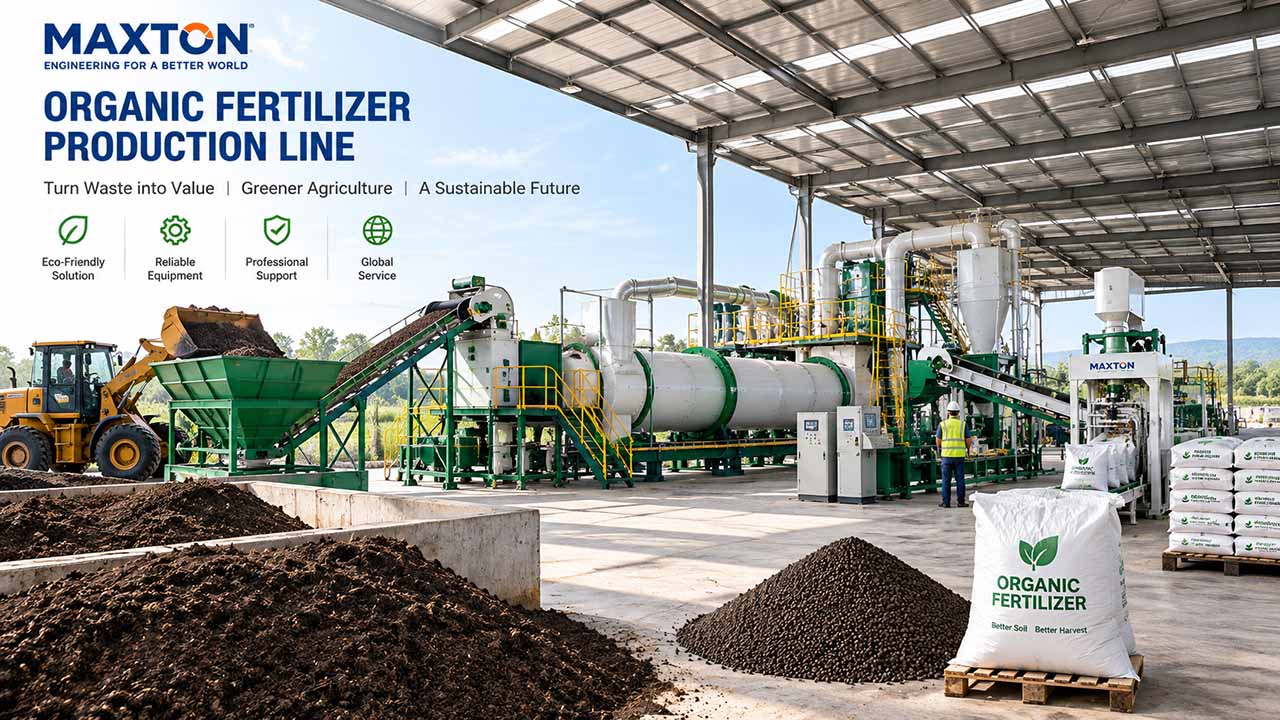
Maxton (Henan Maxton Industrial Co., Ltd.) designs, manufactures, and installs complete BB fertilizer production lines. We serve clients in 75+ countries with equipment tailored to local raw materials, capacity needs, and budget.
Our BB Fertilizer Plant Equipment
| Equipment | Our Specification |
|---|---|
| Automatic batching system | ±0.1% accuracy, 4-12 bins, touchscreen control |
| BB fertilizer mixer | Horizontal ribbon or drum type, batch or continuous |
| Bucket elevators & conveyors | Custom-sized, dust-tight construction |
| Automatic packaging machine | 300-1,200 bags/hour, ±0.2% accuracy |
| PLC control system | Recipe storage for 32+ formulas, data logging |
| Dust collection system | Cyclone or baghouse type |
Turnkey Services
Unlike equipment resellers, Maxton provides end-to-end turnkey solutions:
| Service | Description |
|---|---|
| Process design | Custom layout based on your site and capacity |
| Equipment manufacturing | All core equipment is fabricated in-house |
| Shipping & logistics | Coordinated sea freight to your port |
| Installation supervision | Our engineers guide your local team |
| Commissioning | We start up the line and verify performance |
| Operator training | Your team learns to run and maintain the line |
| Spare parts support | Ongoing supply of wear parts |
Why Choose Maxton for Your BB Fertilizer Plant?
1. In-house manufacturing – We weld, cut, and assemble our equipment. No middlemen, better quality control.
2. Proven in Africa & Asia – Maxton has installed BB plants in Kenya, Nigeria, Ethiopia, India, Pakistan, Indonesia, and more.
3. Fast delivery – Typical lead time: 15-30 days for equipment delivery (after deposit)
4. Competitive pricing – Equipment cost 30-50% lower than European/North American suppliers for equivalent quality
5. 12-month warranty – All equipment covered, with remote troubleshooting support
Case Study: BB Fertilizer Plant in Kenya
In early 2025, Maxton partnered with a major agricultural cooperative in Kenya’s Rift Valley region to install a fully automatic BB fertilizer production line.
Project parameters:
-
Daily output: 200-250 tons/day
-
Formulas supported: 15+ custom NPK blends
-
Batching accuracy: ±0.1% (1/1000)
-
Labor reduction: 12 workers → 5 workers (58% reduction)
-
Payback period: <12 months
Equipment supplied: Automatic batching system (4-6 materials), high-speed BB mixer, automatic bagging machine, PLC control with HMI.
Request a Quote
Contact Maxton for a customized BB fertilizer plant proposal:
Provide the following information:
-
Target capacity (t/h or t/year)
-
Number of formulas you plan to produce
-
Site location (country)
-
Budget range (if established)
Contact Maxton:
-
Website:https://fertifactory.com/
-
Email: svip@maxtonorg.com
-
WhatsApp/Tel: +86-18237180035
10. Frequently Asked Questions
Q1: What is a BB fertilizer plant?
A BB fertilizer plant (Bulk Blending plant) produces blended fertilizers by physically mixing granular raw materials (urea, DAP, MOP, etc.) according to specific formulas. No chemical reaction or granulation is involved.
Q2: How much does a BB fertilizer plant cost?
Equipment cost ranges from 15,000 for a small semi-automatic (3−6t/h) to 250,000+ for a large industrial line (40-50 t/h). Total project investment (including building and installation) ranges from 235,000 to 1,190,000, depending on location and scale.
Q3: How much space do I need for a BB fertilizer plant?
A 10,000 t/year plant needs approximately 40 m²; a 50,000 t/year plant needs 1,000 m²; a 100,000 t/year plant needs approximately 1,600 m².
Q4: What is the difference between BB fertilizer and NPK compound fertilizer?
BB fertilizer is a physical blend of pre-made granules. NPK compound fertilizer is produced through chemical granulation, where N, P, and K are bound together in each granule. BB plants have much lower capital cost and higher formula flexibility.
Q5: Can I produce custom formulas with a BB plant?
Yes. BB plants can store 4-12 different raw materials and blend them in any proportion. Operators can change formulas in minutes by selecting a different recipe on the PLC touchscreen.
Q6: What raw materials do I need for BB fertilizer production?
-
Nitrogen sources: Urea, ammonium sulfate, ammonium nitrate
-
Phosphorus sources: DAP (Diammonium phosphate), MAP (Monoammonium phosphate), TSP
-
Potassium sources: MOP (Muriate of potash), SOP (Sulfate of potash)
-
Additives: Sulfur, magnesium, boron, zinc, other micronutrients
Q7: How accurate is BB fertilizer batching?
Modern automatic batching systems achieve accuracy of ±0.1% to ±0.2%. This ensures every bag meets the labeled nutrient guarantee.
Q8: How long does it take to install a BB fertilizer plant?
Equipment delivery: 15-30 days after deposit. Installation and commissioning: 7-15 days after equipment arrives (assuming civil work is complete). Total from order to production: 30-60 days.
Q9: Is a BB fertilizer plant profitable?
Yes. Industry data shows 30-50% ROI and payback periods of 12-24 months for well-located plants in growing markets.
Q10: Do you provide turnkey installation?
Yes. Maxton provides full turnkey service, including design, equipment, shipping, installation supervision, commissioning, and training.
Summary: Key Takeaways for BB Fertilizer Plant Investors
| Question | Answer |
|---|---|
| What is a BB plant? | Blends granular N, P, K materials into custom fertilizers |
| Equipment cost range | 15,000−250,000+ (depending on capacity) |
| Typical capacities | 3-6 t/h (small) to 30-50 t/h (industrial) |
| Space required | 40 m² – 2,000 m² (depending on scale) |
| Accuracy | ±0.1% to ±0.2% batching precision |
| Payback period | 12-24 months |
| Best markets | Africa, South Asia, Southeast Asia, Latin America |
| Turnkey supplier | Maxton – complete BB fertilizer plant solutions |
About Maxton
Maxton (Henan Maxton Industrial Co., Ltd.) is a specialized manufacturer and turnkey supplier of BB fertilizer production lines.
Our BB fertilizer plant capabilities:
-
Automatic batching systems (±0.1% accuracy)
-
High-speed BB mixers (batch or continuous)
-
Automatic packaging lines (300-1,200 bags/hour)
-
PLC control with HMI (32+ recipe storage)
-
Complete turnkey installation and commissioning
-
75+ countries served
Contact Maxton for your BB fertilizer plant project:
-
Website:https://fertifactory.com/
-
Email: svip@maxtonorg.com
-
WhatsApp/Tel: +86-18237180035
Related Posts
9 月 15, 2026
Fertilizer Plant Cost in 2026: Real Budget Ranges for Organic, Liquid, and NPK Production
Quick answer: A small organic fertilizer plant can start under $50,000. A commercial granular fertil...
8 月 24, 2026
Fertilizer Production Line: A Complete Guide to Equipment, Processes, and Components
What Are the Main Components of a Fertilizer Production Line? A complete fertilizer production line ...
Give us a call or Simply Complete the Form
Address:Zhengzhou City, Henan Province, ChinaPhone:+86-18237180035Email:svip@maxtonorg.com