SINO MAXTON GROUP Co.,Ltd
News Details
NPK Fertilizer Production Line: Complete Equipment List, Process & Cost (2026 Guide) | Maxton
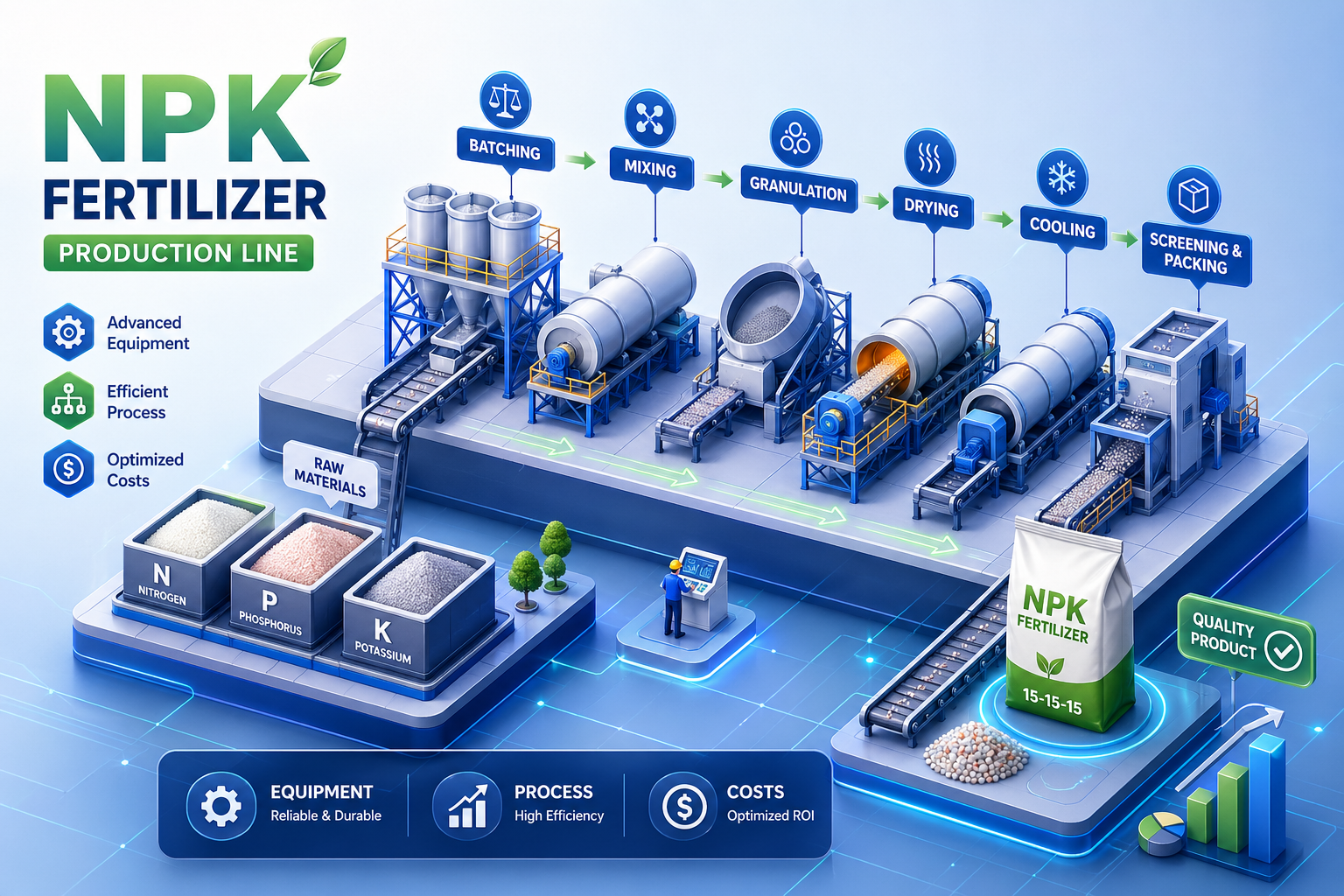
Setting up an NPK fertilizer production line is conceptually straightforward once you understand what each stage does and why it exists. Most buyers, however, enter supplier conversations before they’ve mapped the process, which means they end up reacting to specs rather than driving them. This guide changes that.
We’ll walk through the complete NPK fertilizer production line—from raw material batching through to finished, packed granules. We’ll cover every piece of equipment in sequence, compare the three main granulation methods with honest tradeoffs, and give you real CAPEX ranges by capacity tier.
About Maxton (Henan Maxton Machinery Co., Ltd.): Maxton is a full-scope engineering provider and manufacturer of fully customized NPK granulation lines across modular and industrial scales. From compact single-station units (1-5 t/h) to systems exceeding 30 t/h, Maxton integrates disc, drum, and roller press technology with in-house steel fabrication. This provides a useful frame for the cost and capacity comparisons throughout this guide.
Table of Contents
-
How the NPK Production Process Flows (Raw Material to Finished Granule)
-
NPK Fertilizer Production Line Equipment List (Complete)
-
Drum, Disc, or Extrusion: Choosing the Granulation Method That Fits Your Operation
-
Capacity Tiers and What Each One Demands (Footprint & Configuration)
-
NPK Fertilizer Production Line CAPEX by Capacity (Realistic 2026 Numbers)
-
Cost Drivers That Move the Number Most
-
How to Prepare Before Contacting Suppliers
-
What a Good Turnkey Partner (Like Maxton) Delivers
-
What You Now Know, and What to Do Next
1. How the NPK Production Process Flows from Raw Material to Finished Granule
Understanding the sequence before picking equipment saves you from buying machines that don’t integrate cleanly. The NPK fertilizer production line follows a logical chain: every stage prepares the material for the next one.
Batching and Mixing: Where the NPK Formula Is Built
Raw materials arrive as separate inputs—urea or ammonium nitrate for nitrogen, MAP or DAP for phosphorus, and potassium chloride or potassium sulfate for potassium. An automatic batching machine with a multi-bin electronic belt scale weighs each component to precise proportions before blending.
This stage determines whether your finished granule hits 15-15-15, 20-10-10, or any other target grade, so accuracy here is not optional. Even a 2% deviation in batching can render an entire batch off-spec and unsellable.
A horizontal or double-axis mixer follows, ensuring the blended powder is uniform before it enters the granulator. Maxton’s mixers feature polypropylene liners that prevent material adhesion—a critical detail when switching between sticky formulations like high-N or high-P blends.
Granulation: Where Powder Becomes a Marketable Product
Granulation transforms fine, blended powder into the rounded, free-flowing granules that buyers expect. Depending on the method, this happens through moisture and heat (wet granulation) or high-pressure compression (dry granulation).
The granulation method you choose drives more downstream equipment decisions than any other choice in the project—specifically, whether you need a dryer and cooler, and how large your facility footprint will be.
Drying, Cooling, Screening, and Coating: Finishing the Granule
Post-granulation, wet-process granules carry excess moisture that must be removed before the product is stable for storage:
-
Rotary drum dryer removes moisture to safe levels (typically below 3%)
-
Rotary drum cooler follows, bringing granule temperature down to safe handling levels (ambient + 5-10°C)
-
Screening machine separates on-spec granules (generally 2-5 mm) from fines and oversized product—both of which recycle back into the process
-
The coating machine applies an anti-caking or slow-release coating to the finished granule before it moves to the automatic packer
Auxiliary equipment
Belt conveyors, bucket elevators, and screw conveyors connect every stage. This is the operational connective tissue that determines whether the line runs smoothly or creates bottlenecks. Maxton designs these auxiliary systems specifically to match your throughput and layout, not as generic afterthoughts.
2. NPK Fertilizer Production Line Equipment List (Complete)
A complete NPK granulation line commonly involves 10 to 12 machines operating in sequence. Here is how they break down by function.
Core Process Machines (Preparation to Granulation)
| Equipment | Function | Maxton Capacity Range |
|---|---|---|
| Chain Crusher / Cage Crusher | Raw material lumps and compacted inputs need size reduction before batching | 1-20 t/h |
| Automatic Batching Machine | Portion each input using an electronic belt scale across multiple bins | 1-30 t/h (multi-bin) |
| Horizontal / Double-Axis Mixer | Blends batched powders evenly; polypropylene liners prevent adhesion | 1-30 t/h |
| Granulator (Disc / Drum / Roller) | The center of the line—defines your process; selection cascades into every downstream decision | Varies by type (see Section 3) |
Post-Granulation Machinery (Finishing to Packing)
| Equipment | Function | Maxton Capacity Range |
|---|---|---|
| Rotary Drum Dryer | Removes excess moisture from wet-process granules | 1-25 t/h (matched to granulator) |
| Rotary Drum Cooler | Brings granule temperature down to safe handling levels | 1-25 t/h (matched to granulator) |
| Rotary Drum / Vibrating Screener | Separates on-spec granules (2-5 mm) from fines and oversize | 1-25 t/h |
| Coating Machine | Applies anti-caking or slow-release surface treatment | 1-20 t/h |
| Automatic Packing Machine | Bags finished product | 300-1,000 bags/hour |
Auxiliary Equipment (The Connective Tissue)
-
Belt conveyors for horizontal material movement
-
Bucket elevators for vertical lifting
-
Screw conveyors for enclosed, dust-controlled transfer
-
Cyclone dust collectors for environmental compliance
Maxton Note: Unlike suppliers who source different components from different factories and struggle with integration, Maxton manufactures the core heavy equipment in-house. This means your dryer matches your granulator’s output curve precisely—not “close enough.”
3. Drum, Disc, or Extrusion: Choosing the Granulation Method That Fits Your Operation
This is the highest-stakes decision in the project. Get it right, and the rest of the line spec follows naturally. Get it wrong, and you’re over-investing in equipment you don’t need or under-speccing for your actual throughput.
Maxton builds all three types—disc, drum, and double-roller extrusion—which allows us to give you an honest, unbiased comparison rather than pushing you toward whichever machine we happen to stock.
Steam Drum Granulation: Best Fit for High-Volume Continuous Output
How it works: Rotary drum granulators use steam to promote chemical bonding between NPK components as the drum rotates. The steam activates the raw materials, causing them to agglomerate into rounded granules through a tumbling action.
Capacity range: 15-30 t/h (efficient continuous operation)
Granule quality: Uniform, rounded granules in the 2-5 mm range—commercial standard for most bulk blend and compound fertilizer markets
Process conditions: Optimal performance sits between 60-80°C, with humidity in the 15-20% window. Above those thresholds, binder bonds weaken and material becomes sticky.
The tradeoff: That output volume requires a full drying and cooling circuit downstream, which adds equipment, floor space, and energy cost. You cannot run a wet drum line without matched dryer and cooler capacity.
Best for: Large-scale commercial compound fertilizer plants running the same NPK grades for extended periods. Grade changes are possible but require cleaning and adjustment time.
Disc (Pan) Granulation: Flexibility and a 93% Granulation Rate
How it works: Disc granulators use an inclined rotating pan to roll dampened powder into granules. As the pan rotates, fine particles adhere to larger nuclei, growing into uniform pellets through a snowballing effect.
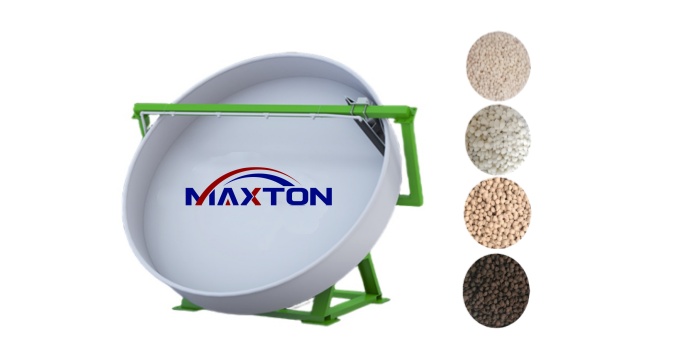
Granulation rate: 93% (industry benchmark for disc systems with proper moisture control)
Capacity range: A practical choice for smaller-scale lines, commonly cited in the 0.5-1 t/h range for mini-plants, with some designs scaling to a few tonnes per hour
The flexibility advantage: Disc granulators are ideal for operations that switch NPK grades frequently, since adjustments to pan angle, speed, and moisture feed are straightforward. You can run 15-15-15 in the morning and 20-10-10 in the afternoon with minimal downtime.
The tradeoff: Like drum lines, disc systems require a downstream dryer and cooler to reach stable moisture content. There’s no “dry disc” shortcut.
Best for: Startups, regional producers, agricultural cooperatives, and operations piloting new NPK grades. Maxton sees disc granulation as the strong default for first-time NPK plant buyers.
Extrusion Granulation: Dry Process, No Dryer Needed, Up to 95% Yield
How it works: Double-roller extrusion granulators press dry NPK powder between two counter-rotating rollers under high pressure. The material is forced into pocket molds on the roller surfaces, forming dense, pillow-shaped granules without adding water or steam.
Granulation rate: Up to 95% (highest of the three methods)
The big advantage: Because no moisture is introduced, the dryer and cooler are eliminated. This shortens the fertilizer granulation line significantly, reduces energy consumption (no burner fuel, no fan motors), and shrinks the facility footprint by 30-40%.
The tradeoff: Granules are denser and more angular (“pillow-shaped” rather than perfectly round). Some buyers associate round granules with higher quality, though agronomic performance is generally equivalent. Raw material moisture must already be low (typically below 5-7%).
Best for: Operations where raw material moisture is low, energy costs are high, water availability is limited, or simplicity is valued over maximum throughput. Extrusion lines are also easier to permit in regions with strict air emission standards (no dryer stack).
Side-by-Side Comparison: Drum vs. Disc vs. Extrusion
| Factor | Steam Drum | Disc (Pan) | Double Roller Extrusion |
|---|---|---|---|
| Typical capacity | 15-30 t/h | 0.5-5 t/h | 1-15 t/h |
| Granule shape | Round, uniform | Round, slightly variable | Pillow-shaped, dense |
| Dryer required? | Yes | Yes | No |
| Cooler required? | Yes | Yes | No |
| Relative energy cost | High | Medium | Low |
| Grade switching ease | Moderate | Easy | Moderate |
| Relative CAPEX (same t/h) | High | Medium | Low to Medium |
| Best application | Industrial continuous | Flexible/small scale | Dry climate, low energy |
4. Capacity Tiers and What Each One Demands in Footprint & Configuration
Choosing a capacity band before approaching suppliers keeps the spec conversation grounded. Here’s how the tiers break down in practical terms for Maxton’s typical clients.
Small-Scale Lines: 1-5 t/h for Startups and Regional Producers
Typical site footprint: 800-1,000 m² total
Who buys this tier:
-
Startup fertilizer businesses
-
Agricultural cooperatives
-
Operators piloting a new NPK grade
-
Regional producers serving local farmers (within a 100-200 km radius)
Configuration advice: At this scale, complexity should be low, and flexibility should be high. Maxton’s compact modular configurations are purpose-built for this tier—they keep equipment count manageable while leaving room to scale the operation as market demand develops.
Granulation method recommendation: Disc or extrusion. Disc gives you flexibility for multiple grades; extrusion eliminates drying cost for single-grade operations with dry inputs.
Typical project timeline: 3-6 months from order to commissioning
Medium-Scale Lines: 5-15 t/h for Commercial Compound Fertilizer Plants
Typical site footprint: 2,000-5,000 m² total (including raw material storage and finished product warehouse)
Who buys this tier:
-
Regional NPK manufacturers supplying multiple provinces/states
-
Agricultural input cooperatives with established distribution
-
Existing single-nutrient fertilizer producers moving into NPK blends
Industry benchmarks for equipment space only (excluding storage/utilities):
-
5 t/h line with full drying and cooling circuit: ~185 m² covered equipment space
-
10 t/h line: ~320 m² covered equipment space
Configuration advice: Automation becomes valuable at this scale. Manual operation is possible, but labor cost per tonne starts to favor semi-automated controls. Maxton typically recommends PLC-based control with touchscreen interface for this tier—enough automation to reduce labor without full industrial complexity.
Granulation method recommendation: Disc or drum, depending on whether you prioritize flexibility (disc) or maximum continuous output (drum). Extrusion remains viable if your raw materials are consistently dry.
Typical project timeline: 4-8 months from order to commissioning
Large-Scale Lines: 15-30+ t/h for Industrial Compound Fertilizer Plants
Typical site footprint: 5,000-10,000+ m² total
Who buys this tier:
-
Large commercial fertilizer manufacturers
-
Export-oriented NPK producers
-
Integrated agribusiness operations
What changes at 20-30 t/h: The line architecture shifts fundamentally. Granulators, dryers, and screeners grow in diameter (Maxton fabricates steel drums up to Ø4.5 m). Automation becomes operationally necessary—you cannot manually control a 30 t/h line. Process control systems move from optional to required, including:
-
Distributed Control System (DCS) or PLC with SCADA
-
Real-time moisture monitoring
-
Automated material tracking and reporting
Maxton’s large-scale fabrication advantage: Unlike suppliers who outsource drum fabrication, Maxton welds, cuts, and forms large-diameter drums in-house. This means shorter lead times and direct quality control for industrial-scale components.
Granulation method recommendation: Steam drum for continuous high-volume production. Disc granulation is generally impractical above 8-10 t/h per machine.
Typical project timeline: 8-14 months from order to commissioning
5. NPK Fertilizer Production Line CAPEX by Capacity (Realistic 2026 Numbers)
Buyers need numbers to write a business case. Here are realistic CAPEX ranges by capacity band, based on current market data and Maxton’s project history across 75+ countries.
Important note on currency and scope: All figures below are USD, FOB China, for equipment and basic engineering. These are not turnkey installed prices (civil works, local installation labor, and utilities are additional). For recent pricing context on raw NPK inputs, refer to industry NPK fertiliser pricing reports.
Small Scale (1-5 t/h)
| Configuration | Investment Range (USD) | What’s Included |
|---|---|---|
| Dry extrusion line (1-3 t/h) | 30,000–60,000 | Crusher, batching, mixer, roller press, screener, packing |
| Dry extrusion line (3-5 t/h) | 50,000–80,000 | Larger roller press + heavier-duty conveyors |
| Wet disc line with drying circuit (1-3 t/h) | 70,000–120,000 | Adds rotary dryer, cooler, cyclone, and burner |
| Wet disc line with drying circuit (3-5 t/h) | 100,000–150,000 | Larger dryer, matched cooler, higher automation |
Why the wide range within each tier: Moisture content of your raw materials, local power availability (single-phase vs. three-phase), and packing automation level (manual fill vs. auto-bagging) all shift the number.
Medium Scale (5-15 t/h)
| Configuration | Investment Range (USD) | Key Variables |
|---|---|---|
| Dry extrusion line (5-10 t/h) | 80,000–180,000 | Roller width and diameter drive cost |
| Wet disc/drum line (5-8 t/h) | 150,000–280,000 | Automation level is the primary variable |
| Wet drum line (10-15 t/h) | 250,000–460,000 | Adds a heavier dryer, larger fan systems, and more advanced controls |
What jumps out: At 10-15 t/h, wet lines require substantially larger drying drums (2.2m+ diameter) and higher-HP fans. The marginal cost per tonne of additional capacity actually increases in this range because you cross a threshold into heavier steel fabrication and more powerful motors.
Large Scale (15-30+ t/h)
| Capacity | Investment Range (USD) | Notes |
|---|---|---|
| 15-20 t/h wet drum line | 400,000–800,000 | Full drying/cooling circuit; industrial-grade controls |
| 20-25 t/h wet drum line | 700,000–1,200,000 | Larger drum diameters (Ø2.5-3.0m) |
| 25-30+ t/h industrial plant | 1,200,000–2,500,000+ | Maxton’s largest configuration; full DCS automation |
Context for the high end: A 200,000 t/year facility (roughly 25 t/h at 8,000 operating hours) can represent a total project investment above $30 million when construction, utilities, site preparation, and infrastructure are included. The equipment is a significant but not the majority portion of the total project cost at an industrial scale.
6. Cost Drivers That Move the Number Most
Four variables shift cost more than anything else. Understanding these helps you decide where to spend and where to save.
1. Granulation Method (The Biggest Driver)
Dry extrusion lines consistently undercut wet granulation lines at equivalent capacity because they cut out:
-
The rotary dryer (typically $30,000-150,000 depending on size)
-
The rotary cooler ($20,000-80,000)
-
The burner/furnace system ($15,000-60,000)
-
Cyclone dust collectors for the dryer stack ($10,000-40,000)
-
Associated fans, ductwork, and fuel infrastructure
Savings estimate: 30-40% lower equipment CAPEX for extrusion vs. wet at the same t/h. Energy savings add another 20-30% reduction in operating cost.
The catch: Extrusion only works if your raw materials are dry (typically below 5-7% moisture). If you’re sourcing wet filter cake or high-moisture inputs, you need drying anyway.
2. Automation Level
Higher automation increases upfront equipment cost but reduces labor cost per tonne over the plant’s operating life.
Manual/Semi-automatic: Lower CAPEX, higher OPEX. For a 5 t/h line, manual operation might require 4-6 operators per shift.
PLC-controlled with touchscreen: Moderate increase in CAPEX (15-25%), reduces labor to 2-3 operators per shift.
DCS/SCADA with full automation: Significant CAPEX increase (40-60% over manual), but reduces labor to 1-2 operators per shift plus a control room supervisor.
Maxton’s typical recommendation: For lines under 5 t/h, manual or semi-automatic is usually cost-effective. For 5-15 t/h, PLC with touchscreen is the sweet spot. For 15+ t/h, full automation pays for itself within 12-18 months through labor savings and reduced off-spec production.
3. Site Preparation and Plant Footprint
Civil works, utilities, and building construction are often underestimated in early project budgets.
Typical site cost categories (rough estimates, vary dramatically by region):
-
Land preparation and grading: $10-50 per m²
-
Concrete foundations for heavy equipment: $20-100 per m² depending on depth and reinforcement
-
Building/cover for equipment (if not open-air): $50-200 per m²
-
Electrical utility connection and distribution: $10,000-100,000, depending on distance and local grid
-
Water supply for wet granulation: $5,000-30,000 for tank, pump, and plumbing
Rule of thumb: Site and civil costs often equal 30-70% of equipment CAPEX, especially in remote locations or regions with expensive construction labor.
4. Procurement Strategy (Piecemeal vs. Turnkey)
Buying equipment piecemeal from multiple suppliers almost always costs more once integration labor, commissioning delays, and support gaps are accounted for.
The hidden costs of piecemeal:
-
Dryer from Supplier A doesn’t match granulator output from Supplier B → bottleneck
-
Conveyor from Supplier C doesn’t align with inlet/outlet heights → custom brackets and rework
-
No single point of responsibility when something doesn’t work → finger-pointing
-
Multiple commissioning visits → extended timeline, travel costs
The turnkey advantage: A well-scoped turnkey solution from a single supplier (like Maxton) compresses project risk and generally delivers better total cost of ownership. You pay a single price, receive integrated equipment, and have one throat to choke when issues arise.
Maxton’s approach: We design, fabricate, and integrate the entire line. If a conveyor doesn’t match the granulator height, that’s our problem to solve—not yours.
7. How to Prepare Before Contacting Suppliers
An informed buyer gets a better proposal. Suppliers scope more accurately when the brief is clear, and you avoid the spec-creep that inflates project costs after contracts are signed.
Five Inputs to Define Before Your First Supplier Conversation
1. Target NPK grades and output capacity in t/h
-
Know whether you need one grade year-round or the flexibility to switch weekly.
-
Be realistic about maximum vs. sustained output. A line rated for 5 t/h maximum might run 3.5-4 t/h sustained.
-
For background on NPK numbers, see agriculture extension resources on “What Is NPK” (external link).
2. Raw material types and local availability
-
What specific inputs will you use? Urea prills vs. granules? MAP vs. DAP? Potassium chloride vs. sulfate?
-
What is the typical moisture content of your inputs?
-
Are your materials free-flowing or sticky?
-
These characteristics influence which granulation method works best.
3. Site area and local utility specs
-
Total available land area
-
Power supply: voltage, phase, frequency, available amperage
-
Water availability: source, pressure, quality (for wet granulation)
-
Access for raw material delivery and finished product shipping
4. Local regulatory requirements
-
EPA and OSHA standards for US-based plants
-
Local equivalents in other countries
-
Emission limits (especially for dryer stacks)
-
Worker safety requirements (guardrails, dust control, etc.)
5. Budget range
-
CAPEX tolerance (equipment + engineering + shipping)
-
Realistic payback horizon (12 months? 24 months? 36+ months?)
-
Available financing structure
The Suppliers Who Appreciate This Information
Suppliers who receive this information produce proposals that reflect your actual project rather than generic line configurations. Maxton’s pre-sales engineering team is designed to work through these five points with you—not force you to figure it out alone.
What a bad supplier response looks like: “We have a standard 5 t/h line for $XX, XXX.”
What a good supplier response (Maxton) looks like: “Based on your urea moisture content of 4% and your stated preference for grade flexibility, we recommend a disc granulation configuration with PLC automation. Here are three layout options for your 900 m² site.”
8. What a Good Turnkey Partner (Like Maxton) Delivers
A turnkey partner manages the full project scope as a single integrated engagement: process design, equipment fabrication, delivery, on-site installation, commissioning, and operator training.
The Turnkey Structure vs. Piecemeal Procurement
| Aspect | Piecemeal Procurement | Turnkey (Maxton) |
|---|---|---|
| Equipment sourcing | You manage multiple suppliers | One supplier, one contract |
| Integration risk | You ensure everything fits | Supplier guarantees integration |
| Installation | You coordinate local labor | The supplier provides installation supervision |
| Commissioning | Multiple vendors, multiple visits (or you figure it out) | Single commissioning team |
| Problem resolution | “Not my machine,” finger-pointing | Single point of responsibility |
| Spare parts | Multiple catalogs, multiple lead times | One source, consolidated shipping |
| Training | None or piecemeal | Comprehensive operator training |
What Maxton Specifically Delivers
Maxton (Henan Maxton Machinery Co., Ltd.) provides this full-scope service for NPK fertilizer production lines, covering disc, drum, and extrusion granulation technologies across the full capacity range.
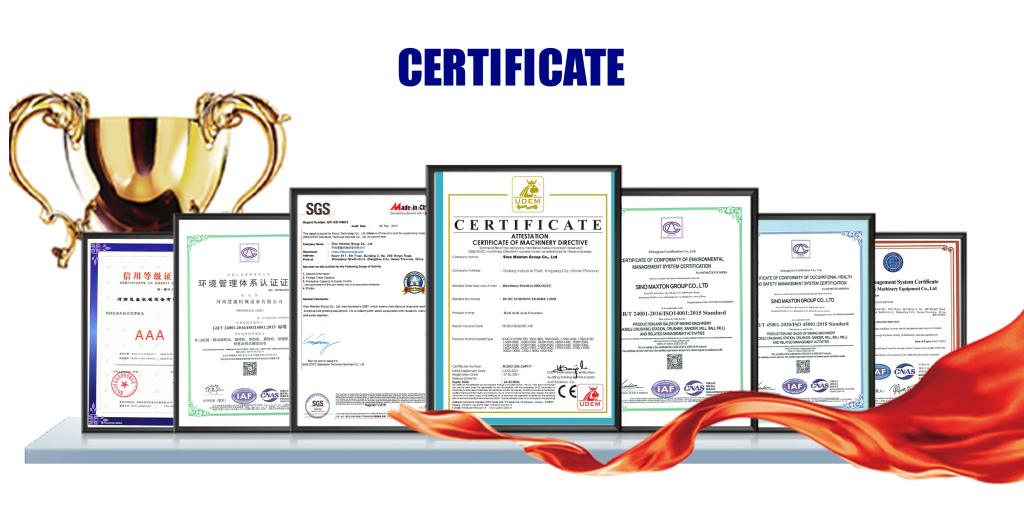
Manufacturing capabilities:
-
In-house steel drum fabrication up to Ø4.5 m diameter
-
In-house welding, cutting, and forming
-
Quality control from raw material to finished machine
Geographic reach:
-
Clients in 75+ countries across Asia, Africa, South America, and the Middle East
-
Export experience with appropriate packing and documentation for each market
Service scope:
-
Process design and line layout
-
Equipment fabrication (not reselling—actual manufacturing)
-
Sea freight coordination
-
On-site installation supervision (optional; can be remote or in-person)
-
Commissioning and operator training
-
Ongoing spare parts support
What Maxton Does NOT Do
Honesty matters in supplier relationships. Maxton does not provide:
-
Local civil construction (building foundations, site grading)
-
Local electrical utility connection (grid to plant)
-
Raw material sourcing or procurement
-
Financing (though we can provide documentation for your lender)
We provide equipment and engineering. Local contractors handle site prep and utilities. This division of responsibility is standard for the industry.
9. What You Now Know, and What to Do Next
The NPK production process follows a clear engineering logic from batching through to packing. The equipment required at each stage is well understood, and the three granulation methods each carry distinct tradeoffs that make the choice rational rather than arbitrary.
Your decision framework:
-
Low moisture inputs + want the lowest CAPEX + don’t need round granules? → Extrusion
-
Need grade flexibility + small to medium scale? → Disc granulation
-
High volume continuous output + round granules required? → Steam drum
CAPEX is real and estimable, not a black box. For a 1-5 t/h line, budget 30,000−150,000. For 5-15 t/h, 100,000−460,000. For 15-30+ t/h, 400,000toover2.5 million for equipment alone.
The difference between a strong supplier relationship and a painful one often comes down to how clearly you’ve defined the project before the first conversation.
An NPK fertilizer production line is a mature technology. What remains is matching the right configuration to your specific feedstock, capacity, site, and budget. That matching process is where a strong turnkey partner earns their value.
Your Next Step
If you have a target capacity and NPK grade in mind, the next step is having that spec validated by a supplier who can translate it into a site-specific line design.
Contact Maxton:
Maxton’s pre-sales process is designed to work through your specific scope from the first inquiry. Our engineering team will:
-
Review your raw materials and target output
-
Recommend a granulation method based on your inputs (not our inventory)
-
Provide a preliminary layout drawing for your site
-
Quote equipment with clear line-item transparency
-
Connect you with past clients in your region for reference calls (upon request)
Request a configuration recommendation before committing to a purchase order. Contact Maxton via the website or email your project brief to our sales engineering team.
About Maxton (Henan Maxton Industrial Co., Ltd.)
Maxton manufactures and integrates complete NPK fertilizer production lines for clients in 75+ countries. Core capabilities include:
-
Disc granulators for flexible, small-to-medium scale production
-
Rotary drum granulators for industrial-scale continuous output
-
Double-roller extrusion presses for dry-process, no-dryer configurations
-
Rotary dryers and coolers (in-house fabricated up to Ø4.5 m)
-
Complete auxiliary systems (crushers, mixers, screeners, coaters, packers, conveyors)
Unlike trading companies or machine brokers, Maxton fabricates the core heavy equipment in-house. This means shorter lead times, direct quality control, and single-source responsibility for your NPK granulation plant.
Contact Information:
-
Website: www.fertifactory.com
-
Email: svip@maxtonorg.com
-
Phone: +86-18237180035
Related Posts
9 月 15, 2026
Fertilizer Plant Cost in 2026: Real Budget Ranges for Organic, Liquid, and NPK Production
Quick answer: A small organic fertilizer plant can start under $50,000. A commercial granular fertil...
8 月 24, 2026
Fertilizer Production Line: A Complete Guide to Equipment, Processes, and Components
What Are the Main Components of a Fertilizer Production Line? A complete fertilizer production line ...
Give us a call or Simply Complete the Form
Address:Zhengzhou City, Henan Province, ChinaPhone:+86-18237180035Email:svip@maxtonorg.com