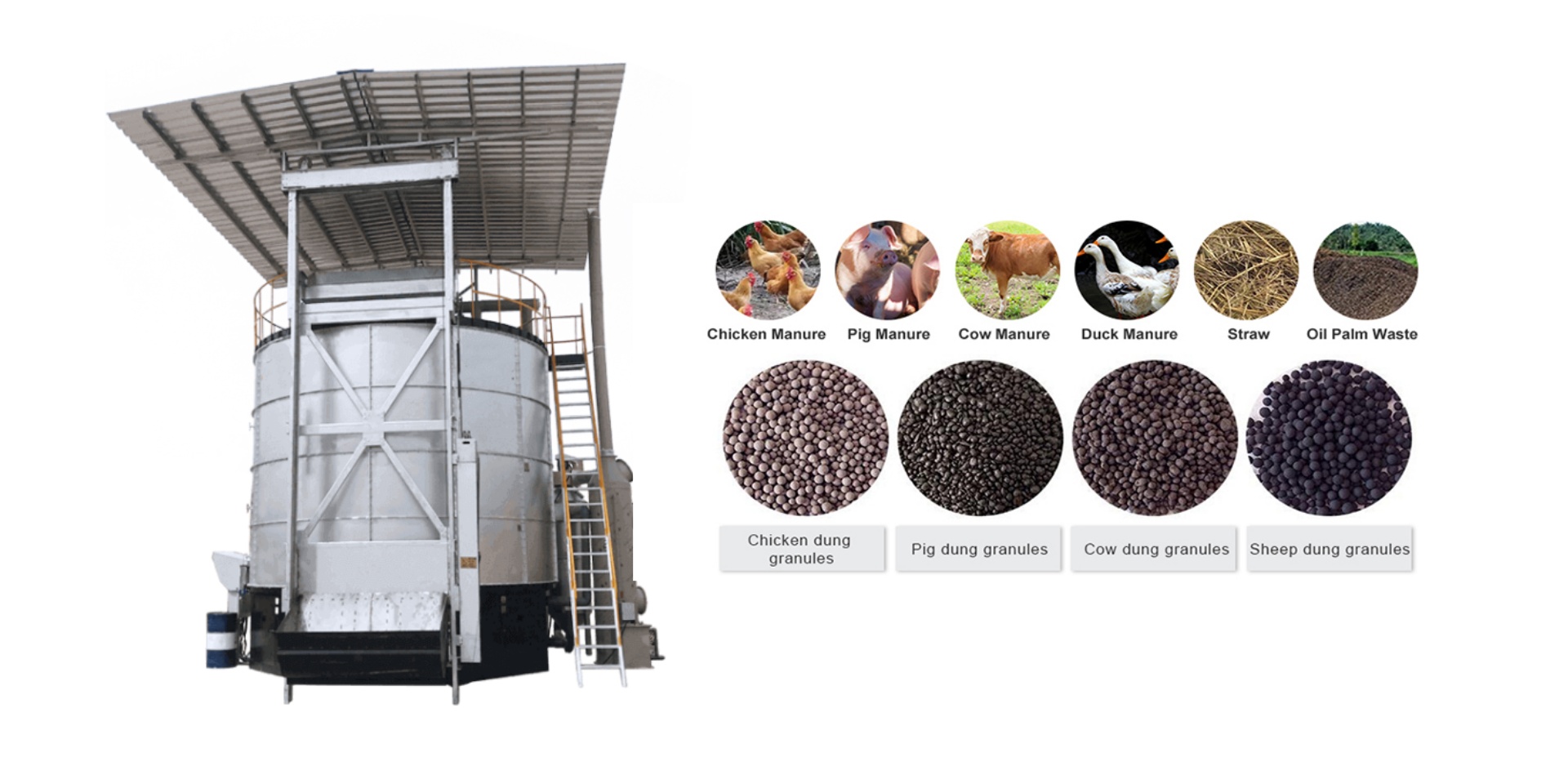

Composting Equipment : organic fertilizer fermentation tank, compost turner
We offer various models of composting equipment to meet the different needs and sizes of our customers. Whether it is organic waste on a domestic, agricultural, or industrial scale, we have a composter for you. Our composter has high processing efficiency and can quickly convert organic waste into high-quality compost, providing users with a convenient composting solution.
Organic Fertilizer Fermentation Tank for Sale
Technical Parameters of Organic Fertilizer Fermentation Tank
| Parameter | Value | Parameter | Value |
|---|---|---|---|
| Tank Height | 8440 mm | Tank Diameter | 5500 mm |
| Tank Volume Height | 3900 mm | Minimum Floor Area | 55 m³ |
| Tank Volume | 86 m³ | Bottom Blower | 11*2 km/h |
| Treatment Capacity | 7~10 m³/day | Output | 3~4.5 m³/day |
| Daily Water Consumption | 1m³(kw.h) | Power Supply | 380V50Hz |
| Hopper Volume | 1.35 | Hydraulic Station | 7.5+2.2 kw |
| Induced Draft Fan | 3 km/h | Spray Tower | 1.5 kw/h |
| Auxiliary Heater | 4 km/h | Discharge Device | 2.2 kw/h |
| Installed Power | 43.5 | Operating Power | About 25 kw/h |
* Note: Specifications may vary depending on model and customization requirements.
Working Principle of Fermentation Tank
The overall configuration of the fermentation tank for organic fertilizer is segmented into three main parts. The lower base section incorporates essential elements such as the wave pressure station, vortex air pump, oil cylinder, heating system, and stirring shaft.
The central section comprises a dual-layer insulated tank, an automatic control system, and an outlet mechanism. Constructed with a 304 stainless steel plate inner wall and a polyurethane foam insulation layer in the middle, the tank's outer wall is supported by a thickened steel plate. Positioned above the tank are a weather shed, a testing platform, and exhaust facilities. Additional features include an automatic bucket elevator, an exhaust gas filtration and deodorization system, and a heat exchange system.
Compost Turner for Sale
Technical Parameters of Compost Turner
| Model | SL-2300 | SL-2600 | SL-3000 | SL-3000A |
|---|---|---|---|---|
| Turning Width | 2300 mm | 2600 mm | 3000 mm | 3000 mm |
| Turning height | 600-1000 mm | 1100-1300 mm | 1300-1500 mm | 1600-1800 mm |
| Working Speed | 6-10m/min | 6-10m/min | 6-10m/min | 6-10m/min |
| Power | 75 kw | 116 kw | 136 kw | 143 kw |
| Capacity | 500-700m³/h | 1000-1200m³/h | 1300-1500m³/h | 1500-1800m³/h |
Working Principle of Compost Turner
Compost turners are typically equipped with rotating blades or paddles that are driven by a motor. As the compost turner moves through the compost pile, the blades or paddles agitate the material, breaking up clumps and promoting the mixing of oxygen-rich air with the organic matter.
This agitation and aeration help to accelerate the decomposition process by providing oxygen to aerobic microorganisms, which break down organic materials into compost. Additionally, the turning action helps to redistribute moisture and heat within the compost pile, creating optimal conditions for microbial activity.
Organic Fertilizer Fermentation Tank vs. Compost Turner
Comprehensively consider the type, scale, processing needs and expected fermentation effect of organic waste, and flexibly select organic fertilizer fermentation tanks or compost turning machines according to specific circumstances. Learn more…
| Item | Organic Fertilizer Fermentation Tank | Compost Turner |
|---|---|---|
| Odor Treatment | Yes, our fermentation tank is a closed structure and equipped with a deodorization system to remove odors | No, the raw materials are exposed to the air, and workers and the surrounding people need to tolerate the odors |
| Processing Time | Only need 7 days | Needs at least 15-30 days |
| Space Occupied | 60㎡ | Needs hundreds of square meters with the same capacity |
| Continuous Processing | Yes, if using our method, customers can input raw material every day and get the final product every day | No, it’s batch production. Customers have to input raw materials at least every 15-30 days, which means they can get one batch every 15-30 days |